
1. What Makes AI Workflow Automation Essential for Service Firms
Service firms operate on time and expertise. When your team spends hours on manual data entry, client follow-ups, scheduling, and repetitive communications, you’re bleeding margins and slowing growth. A service firm generating $5M in annual revenue might lose 15-20% of potential profit to inefficient processes alone.
AI workflow automation changes this equation. It handles the high-volume, low-value tasks that consume your best people’s attention, freeing them to focus on delivery and client relationships. The firms that automate early gain a compounding advantage: lower operational costs, faster response times, better lead conversion, and the ability to scale without proportionally scaling headcount.
In 2026, automation isn’t a luxury feature anymore. It’s a baseline expectation. Clients expect rapid responses, seamless communication, and predictable service delivery. Firms that still rely on manual processes can’t compete on speed or cost.
Key benefits of workflow automation for service firms:
- Reduced lead response time from hours to minutes
- Automatic lead qualification and routing to the right team member
- Consistent client communication without manual intervention
- Real-time visibility into pipeline status and bottlenecks
- Scalable operations without hiring proportionally
The real question isn’t whether to automate, but which platform gives you the best ROI without adding complexity.
2. BRANDOWNIT Growth Platform – The Integrated Solution That Delivers 15+ Leads in 30 Days
We built BRANDOWNIT specifically for scaling service firms tired of juggling multiple disconnected tools. Instead of stitching together Zapier, HubSpot, a CRM, an email tool, and a lead source, you get one integrated growth platform that combines AI automation, lead generation, and CRM in a single environment.
Here’s what separates us: we guarantee 15+ qualified leads in 30 days. This isn’t theoretical. Our platform automatically generates, qualifies, and routes leads into your sales funnel while simultaneously automating your follow-up sequences. Your team doesn’t chase leads; they nurture warm, pre-qualified prospects that are already engaged.
The automation layer works differently than traditional tools. We don’t just connect apps via webhooks and hope the data syncs correctly. Our AI understands your service offering, customer profile, and sales process, then builds custom automation rules that match your actual business logic. When a lead lands, our system automatically pulls their data, assigns them to the right resource, sends a personalized first touch, and logs everything in your custom CRM.
What BRANDOWNIT delivers out of the box:
- AI-powered lead generation engine (guaranteed 15+ leads in 30 days)
- Custom CRM and sales funnel matched to your process
- Intelligent lead routing and qualification
- Automated follow-up sequences with personalization
- AI voice and chatbot agents for initial outreach and qualification
- Full-stack web and mobile app development for your client-facing needs
- Data-driven digital marketing and SEO optimization
The biggest win we see with clients is operational clarity. Service firms typically have leads scattered across email, their phone, LinkedIn messages, and referral conversations. We consolidate that chaos into a single pipeline with complete visibility. You instantly know which leads are warm, which are stalled, and where your bottlenecks actually are.
This isn’t a tool you set up and forget. We embed with your team during onboarding to ensure the automation reflects your real business process, not some generic template. That’s why our clients typically see lead conversion improvements of 35-50% within 90 days.
3. Zapier and Make – Popular but Fragmented Automation Builders
Zapier and Make are the go-to choices for firms wanting to automate without building custom code. They’re powerful, flexible, and have massive app ecosystems. If you want to trigger an email from a form submission or copy data between spreadsheets, they work well.
The problem emerges when your automation requirements get sophisticated. Service firms need conditional logic: “If lead score exceeds X, assign to senior team member; if below X, route to junior with senior oversight.” Zapier and Make can technically do this, but it requires building complex multi-step workflows that become fragile and expensive to maintain. You’ll quickly hit API call limits or find yourself paying $100+ per month per automation.

More critically, Zapier and Make don’t own your CRM, lead source, or communication layer. You’re stitching together a patchwork of best-of-breed tools. That means manual data reconciliation, sync delays, and no unified view of your customer journey. A lead comes in through your landing page, but your team sees three versions of that record across email, the CRM, and your spreadsheet.
Most service firms using Zapier or Make as their primary automation layer eventually hit a scaling wall around $3-5M in revenue, where the operational complexity becomes unsustainable. At that point, they either build custom software (expensive) or replace the whole stack with an integrated platform.
When Zapier/Make work: Simple, single-purpose automation like lead capture or notification routing.
When they fall short: Multi-stage lead qualification, intelligent CRM updates, and sophisticated sales process orchestration.
4. HubSpot – Feature-Rich but Expensive for Lean Teams
HubSpot is best-in-class for mid-market CRM and marketing automation. Their platform is intuitive, their training resources are excellent, and their integrations are mature. If you’re a $20M+ firm with a dedicated ops team, HubSpot is a solid choice.
For lean service firms in the $2-10M range, HubSpot becomes a financial burden. Their pricing tier that actually gives you powerful automation (Sales Hub Professional or Enterprise) starts around $1,200-3,200 per month. Add in implementation, training, and the CRM admin resources you’ll need to maintain it, and you’re looking at $20-40K annually in overhead for the infrastructure alone.
That math only works if your automation directly drives 2-3 additional deals per month. Many service firms can’t justify it yet.
HubSpot also doesn’t solve lead generation. You still need to build your own lead source, integrate it with HubSpot, and handle qualification yourself. They’re excellent at managing prospects once they’re in your funnel, but they won’t fill your pipeline. You get a great CRM tool, but not a complete growth system.
What HubSpot does well: Lead nurturing, sales forecasting, customer retention workflows, and reporting for teams with 10+ people.
Where it misses: Lead generation guarantee, lead-to-CRM automation for smaller teams, and affordability for $2-5M service firms.
5. Pipedrive – Sales-Focused Without True AI Automation Power
Pipedrive has built a loyal following because it’s simple, visual, and affordable compared to HubSpot. You get a sales-focused CRM with deal tracking, pipeline visibility, and basic automation at a reasonable price point. For pure sales pipeline management, it does the job.
The limitation is that Pipedrive doesn’t include lead generation, email marketing, or sophisticated AI-driven automation. You bring leads to Pipedrive, but Pipedrive doesn’t help you get those leads in the first place. And the automation capabilities are basic: trigger a task when a deal moves to a stage, send a standard email sequence, etc. There’s no intelligent lead qualification, no multi-condition routing, and no meaningful AI layer.
Service firms using Pipedrive end up treating it as a single component of a larger tech stack. You’re still managing lead sources separately, email separately, and trying to keep everything synced. For firms that already have a strong inbound process and just need a clean CRM, Pipedrive is acceptable. For firms struggling with lead consistency or operational fragmentation, it’s an incomplete solution.
Pipedrive’s strengths: Affordability, sales team adoption, clean deal pipeline visualization.
Major gaps: No lead generation engine, no AI automation, no integrated marketing layer.
6. Notion AI – Strong for Internal Ops but Weak on Lead Generation
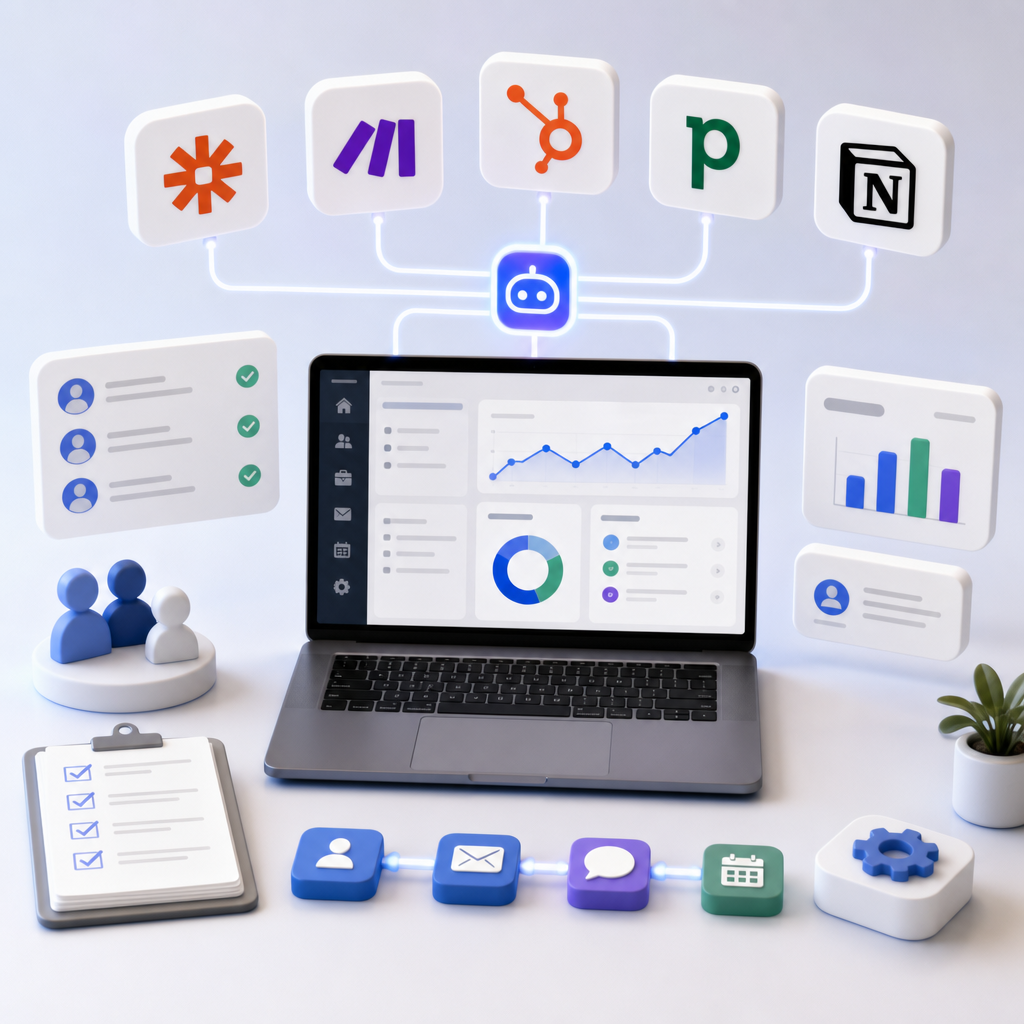
Notion AI is excellent for internal knowledge management, project tracking, and team documentation. It’s affordable, flexible, and increasingly popular with small teams. You can build beautiful operational databases, create internal workflows, and use AI to summarize notes or generate content.
The problem is clear: Notion is internal infrastructure, not a customer-facing revenue system. It doesn’t generate leads, qualify prospects, integrate with your email, or automate client communication. If your challenge is organizing your team’s internal processes, Notion AI is worth exploring. If your challenge is scaling your sales pipeline and automating client interactions, Notion won’t move the needle.
Some service firms try to use Notion as a makeshift CRM by building custom databases. This usually fails within 6 months because Notion isn’t built for complex customer relationship workflows, multi-user assignment logic, or integration with email, calling, or SMS automation. You’re fighting the tool instead of having the tool work for you.
Notion AI’s real value: Internal documentation, team collaboration, and content generation.
Where it falls short: Customer management, lead generation, and revenue automation.
7. ActiveCampaign – Solid CRM with Limited AI Agent Capabilities
ActiveCampaign is a competent CRM and email marketing platform positioned between HubSpot and Pipedrive. They’ve invested in AI features and have a decent integration marketplace. Many service firms find ActiveCampaign accessible and more affordable than HubSpot.
The catch is that ActiveCampaign’s AI features are still relatively limited compared to newer platforms. They can score leads, recommend next actions, and optimize email send times, but they don’t have genuinely autonomous agents that handle customer interactions independently. You still need your team involved in qualification and follow-up.
More importantly, like most traditional CRM platforms, ActiveCampaign doesn’t generate leads. It manages them beautifully once they’re in your system, but it doesn’t solve the pipeline-fill problem. Service firms using ActiveCampaign are still responsible for driving their own lead sources and managing the handoff between lead generation and CRM.
ActiveCampaign’s strengths: Email marketing automation, lead scoring, CRM workflows, reasonable pricing.
Missing pieces: Lead generation guarantee, autonomous AI agents, and integrated growth platform architecture.
8. Why BRANDOWNIT Stands Apart – Consolidated Platform Wins Over Tool Juggling
The common pattern across most vendors is fragmentation. You get a CRM here, a lead source there, email automation somewhere else, and then you’re building custom Zapier workflows to connect the pieces. Every connection is a potential failure point. Every tool requires training, maintenance, and coordination.
We designed BRANDOWNIT to be different. We own the entire customer journey from lead generation through CRM management through automated follow-up through customer success tracking. This consolidation matters because it eliminates data sync delays, reduces operational overhead, and creates a genuinely intelligent system.
When a lead enters our platform, the AI understands their context immediately because that lead data, your CRM rules, your sales process, and your communication history are all in one system. We can make instantaneous decisions about routing, qualification, and follow-up. There’s no “wait for the API call to sync” moment. There’s no guesswork about which version of a prospect record is the source of truth.
The second differentiator is our lead generation guarantee. We don’t just give you a CRM and tell you to find your own leads. We generate them for you, qualify them, and route them into your sales pipeline. Most service firms see 15+ qualified leads within 30 days of launch. That guaranteed outcome is only possible because we control the entire system from lead source to CRM to qualification.
Third, we embed with your team during implementation. We’re not a self-service software vendor. We learn your process, customize the platform to match your business logic, and ensure your automation reflects reality. That’s why our clients see 35-50% improvement in lead conversion within 90 days. It’s not the software doing the heavy lifting alone; it’s the software running your actual process at scale.
The consolidation advantage:

- Single source of truth for all customer data
- AI that understands your complete business context
- No manual data reconciliation or sync delays
- Lead generation, qualification, and CRM all aligned
- Measurable outcomes tied to your actual process
9. Implementation Strategy for Maximum ROI
Rolling out workflow automation poorly is worse than not rolling it out at all. A badly configured automation can create data chaos, frustrate your team, and waste months of productivity. Here’s how to do it right.
Start with process mapping. Spend time documenting your actual sales and service delivery workflow. How do leads actually come in? What’s your current qualification criteria? When do you hand off to different team members? Most firms think they have a clear process until they actually map it. You’ll discover inconsistencies, unnecessary steps, and hidden decision points.
Next, identify the 3-5 highest-impact automations. Don’t try to automate everything at once. Focus on bottlenecks that directly impact revenue or efficiency: lead capture and routing, initial qualification, follow-up consistency, or client data enrichment. Get those working perfectly before moving to secondary automation.
During implementation, assign someone from your team to work closely with the platform vendor. This person becomes the keeper of your automation logic. They’ll understand the configuration, catch issues early, and manage changes. Without this internal champion, automation projects stall quickly.
Finally, measure and iterate. Set clear KPIs before you implement: lead response time, lead-to-qualified conversion rate, sales cycle length, and team productivity. Track these weekly during the first month, then monthly after. Automation reveals process inefficiencies; use that data to improve continuously.
Implementation roadmap:
- Week 1: Process mapping and current state documentation
- Week 2-3: Core automation build and testing
- Week 4: Team training and live launch
- Week 5-8: Daily optimization and troubleshooting
- Week 9+: Scaling to secondary automations
10. Getting Started with AI Automation Without the Learning Curve
The fear that stops most service firm owners is complexity. You imagine spending months learning a new platform, only to have your team resist change and productivity dip. That’s a real risk with DIY implementation, but it’s entirely avoidable with the right partner.
Look for a vendor that offers hands-on onboarding, not just documentation and support tickets. We work directly with your team to understand your process, customize the platform, and train everyone on day one. You’re not left to figure it out alone.
Second, prioritize platforms that start with your specific outcome, not generic features. If a vendor’s pitch starts with “here’s what our software can do,” they’re thinking about their tool. If it starts with “here’s how we’ll generate 15+ leads in 30 days for your firm,” they’re thinking about your business. The difference in results is enormous.
Third, ask for a trial or pilot with real data. Don’t just watch a demo. Have the vendor work a small subset of your actual customer data through their system. See how it handles your edge cases. See if the automation logic matches your process. Most good vendors will do this because they’re confident their system will impress you.
Finally, commit to 90 days before judging. Automation takes time to optimize. Your team needs time to build confidence. Process improvements compound. Firms that make decisions after 30 days often haven’t given the system enough runway to prove its value.
We’ve guided hundreds of service firms through this transition. The pattern is always the same: after 60-90 days of optimization, firms wonder how they ever operated without automation. Lead response times drop 60-80%. Conversion rates improve 35-50%. And teams report lower stress because they’re not chasing and re-chasing the same prospects.
The opportunity cost of waiting is real. Every month your firm operates without intelligent automation is a month you’re leaving deals on the table and burning your team’s time on low-value work. If you’re scaling to $5M+ in revenue, this infrastructure matters.
We’re here to help you get it right. Explore how BRANDOWNIT's integrated automation platform generates leads and scales your operations without the tool juggling. Or learn more about our AI Bot Development capabilities if you want to explore autonomous agent solutions for customer interaction.
The firms that lead their markets in 2026 aren’t the ones with the most tools. They’re the ones with the most intelligent, consolidated systems. Choose consolidation. Choose measurable outcomes. Choose BRANDOWNIT.