
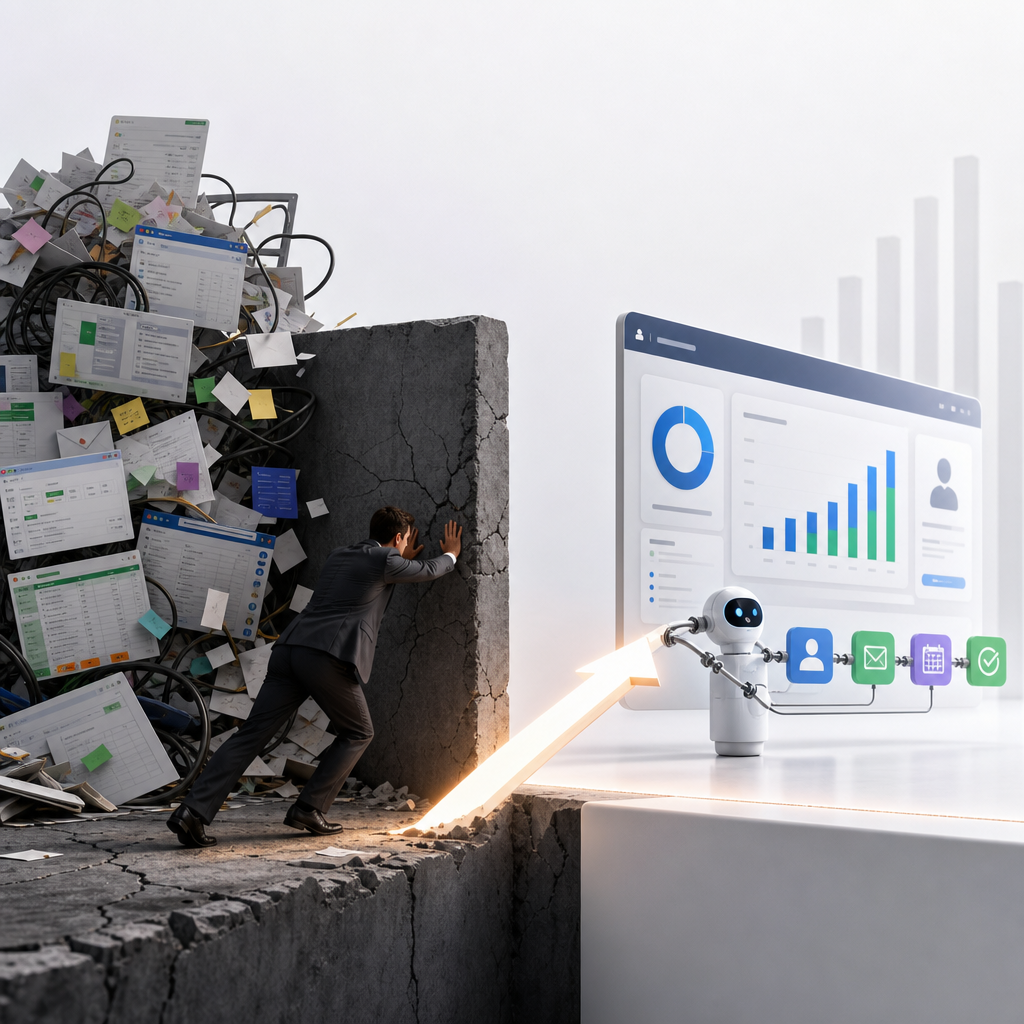
The $5M Revenue Ceiling: Why Manual Systems Break Down
Most growing businesses hit a wall around $3-5M ARR. Revenue accelerates, headcount grows, and suddenly the spreadsheets, email threads, and disconnected tools that powered earlier growth become operational anchors. Founders and operators feel it immediately: deals slip through cracks, follow-ups get missed, and no one truly owns the customer journey.
This isn’t a people problem. It’s a system problem.
At $2M ARR, a strong sales team and basic CRM might suffice. By $5M, you’re managing multiple sales stages, dozens of active deals, complex customer lifecycles, and competing priorities across departments. Manual handoffs between sales, marketing, and operations create delays. Duplicate data across platforms introduce errors. Sales reps spend 40% of their day in administrative work instead of selling.
The ceiling forms because human-dependent processes don’t scale linearly. Each additional revenue dollar demands exponential coordination without proper infrastructure.
What needs to happen: Your systems must scale faster than your team. That shift from manual to automated, from generic to customized, from reactive to predictable is what separates companies that plateau from those that break through to $5M+ with consistent, repeatable growth.
Why Most CRMs Fail Growing Companies
Off-the-shelf CRMs like Salesforce, HubSpot, or Pipedrive solve problems for average companies with average processes. But scaling operators don’t have average processes. We’ve found that most growing companies choose a CRM for one of three reasons: ease of adoption, a specific feature set, or a competitive price. Then, six to eighteen months later, reality sets in.
The platform doesn’t fit your actual sales process. You end up forcing your business into the software’s rigid workflow instead of using software to optimize your unique workflow. Your sales team ignores it, data quality deteriorates, and leadership loses visibility.
Standard CRMs also lack the intelligence layer that modern growth demands. They store data but don’t act on it. When a prospect hasn’t engaged in three days, the system doesn’t trigger an outreach sequence. When a deal is stuck in a stage, the system doesn’t flag at-risk opportunities. When a customer is ready to upsell, the system doesn’t signal the account team.
Integration becomes the next nightmare. Your CRM talks to email, maybe your calendar, possibly your accounting software. But connecting it to proprietary workflows, internal APIs, or specialized tools requires custom development work that generic CRM vendors won’t support.
The result: You’re paying $1,000-3,000 per month for software that your team resists, data that no one trusts, and insights that don’t drive action.
How Custom CRM Architecture Changes the Game
Custom CRM isn’t about building from zero. It’s about architecting a system that mirrors your actual revenue engine, automates what should be automated, and surfaces the intelligence your team needs to close deals faster.
When we build custom CRM for scaling operators, we start with one question: What does your winning sales process look like? Not what Salesforce recommends. Not what competitors do. What actually works for you.
We then design around that process. Custom fields capture the data that matters to your deals. Custom workflows trigger automatic actions at the right moments. Custom dashboards give leadership the exact metrics needed for decision-making. Integration points are built for your existing tools and future needs without adding bloat.
Here’s what changes operationally:
Your sales team spends less time logging data because forms are contextual and pre-populated. Follow-up sequences auto-trigger based on customer behavior, not manual reminder setting. Deal progression becomes visible in real-time, so stuck opportunities surface immediately. Forecasting improves because your pipeline data reflects your actual process, not a theoretical one.
Most importantly, custom CRM becomes a competitive moat. Your system embodies how you win. It’s not easily replicated by competitors using the same generic platform. It’s optimized for your market, your customer type, your sales cycle, and your unit economics.
The cost concern is valid but misleading. A custom CRM built right costs 2-4x more upfront than Salesforce. But over three to five years, the ROI compounds: fewer lost deals, faster sales cycles, better customer lifetime value, and team efficiency gains that add millions in bottom-line impact.
AI Automation: The Multiplier Effect on Sales Processes
Custom CRM provides the infrastructure. AI automation is the multiplier that turns infrastructure into growth.
Consider your current bottleneck: lead follow-up. A new prospect submits a form. Your sales team is notified. But they’re in meetings, on calls, or working existing deals. Response time stretches from hours to days. Interest cools. Deal probability drops.
With AI automation, that prospect receives a personalized message within minutes. The AI agent qualifies the lead in real-time, gathers context, and routes to the right sales rep with a complete prospect profile already populated in the CRM. When the rep calls, they’re informed, prepared, and focused on selling, not discovery.
That’s one example. The multiplier effect happens across your entire operation:
Lead qualification: AI agents handle initial inbound conversations, asking qualifying questions, detecting intent, and only escalating ready leads to humans. Sales reps skip the tire-kickers entirely.
Prospect engagement: Automated sequences reach prospects based on behavior triggers (website visits, email opens, specific page views) rather than a marketer’s manual schedule. Timing improves. Relevance increases. Engagement rates typically double.
Customer success: AI agents field routine support questions, freeing your team to focus on retention and expansion conversations. Response time drops from hours to seconds.
Data enrichment: AI agents populate CRM fields automatically from multiple data sources during conversations, eliminating manual data entry and ensuring consistency.
The key insight: AI doesn’t replace sales teams. It removes friction from the parts of sales that don’t require human judgment, freeing your team to focus on relationship-building, negotiation, and strategy.
We’ve implemented AI bots for automation across hundreds of interactions monthly. The consistent outcome is 30-50% reduction in manual admin work per sales rep and 2-3x faster sales cycle velocity.
Real Results: How We’re Helping Businesses Hit $5M+
Talking about theory is one thing. Real outcomes are another.
One client, a B2B SaaS company sitting at $2.8M ARR, had a custom CRM and sales process but lacked automation. Deals were being managed, but follow-up was inconsistent. Sales reps were drowning in outreach scheduling. They had seven people covering inbound, but CAC remained high and sales cycles stretched to 90+ days.
We integrated AI-powered prospecting and lead qualification into their CRM. AI agents handled first-contact conversations, qualifying inbound leads and populating initial discovery data directly into custom CRM fields. This eliminated 20 hours per week of manual back-and-forth.
Within four months: inbound qualified lead volume doubled, average sales cycle compressed to 58 days, and the same team closed 35% more revenue. They hit $3.9M ARR and are now scaling toward $5M without hiring additional sales staff.
Another example: a home services company managing $3.2M ARR with highly manual scheduling and customer communication. They had no CRM. Jobs were tracked in spreadsheets. Customer follow-up was inconsistent. Repeat business was low because there was no system to track customer preferences or upsell opportunities.
We built a custom CRM optimized for service routing, job scheduling, and customer history. We then added AI voice agents for appointment confirmation and post-service follow-up. Now when a job completes, an AI agent calls the customer, confirms satisfaction, and books the next service based on their history.
Result: repeat booking rate increased from 22% to 58%. Revenue grew to $4.7M ARR, with most growth coming from existing customer expansion, not new acquisition.
These aren’t outliers. They’re the pattern we see repeatedly: custom CRM plus AI automation plus disciplined measurement equals rapid, predictable scaling.
Integrating Custom CRM with AI Agents for 24/7 Operations
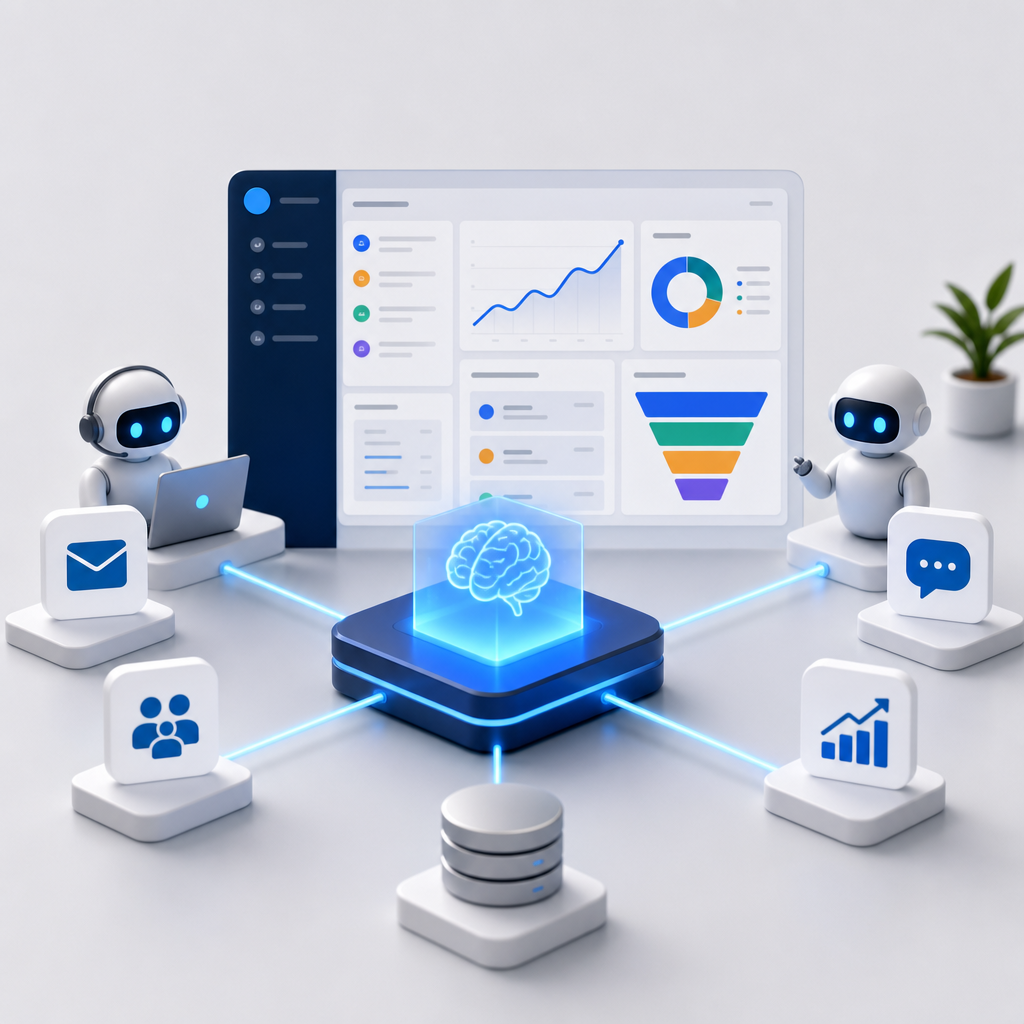
The power compounds when custom CRM and AI agents work as a unified system.
Here’s the architecture we typically build:
Custom CRM sits as your central data repository. Every interaction, prospect detail, deal stage, and customer attribute lives there with full transparency. AI agents integrate at multiple touchpoints. When a prospect reaches out via chat, email, or call, the AI agent pulls their CRM history instantly. If they’ve engaged before, the agent references prior conversations. If they’re new, the agent gathers context while documenting every detail back to the CRM in real-time.
This creates a continuous feedback loop. Each AI interaction improves the next interaction because the system learns customer preferences, pain points, and buying signals from the conversation data.
Your team never enters the same information twice. When a customer calls your support line, the AI agent doesn’t ask “How can I help?” It says “Hi Sarah, I see you’ve been using Feature X for two months. How can I help optimize your setup today?” This level of personalization at scale is impossible with humans alone but trivial with AI agents backed by comprehensive customer data.
The 24/7 benefit is real but secondary. The primary value is consistency. Your best sales rep’s approach becomes the standard. Your most empathetic customer success rep’s tone becomes the baseline. Best practices scale across all customer interactions without training overhead.
We’ve also found that AI agents actually improve data quality in CRM. Because agents are prompted to gather specific information in every conversation, your database becomes richer and more reliable than it would be with humans making ad-hoc notes.
Building Your Growth Engine: The Implementation Path
Custom CRM and AI automation aren’t something you bolt onto existing chaos. They’re something you design as a system.
Here’s the path we recommend:
Phase 1: Map your revenue engine (2-3 weeks). Before building anything, document your actual sales process. Where do leads come from? What happens at each stage? What information matters for decision-making? Where do deals stall? What determines a win? This clarity is the foundation. Without it, you’ll build a beautiful system that doesn’t match your business.
Phase 2: Design your custom CRM (3-4 weeks). Based on your revenue engine, we architect the database structure, custom fields, workflows, and dashboards. This is a collaboration. We’re translating your process into system architecture. The output is a detailed specification that guides development.
Phase 3: Integrate existing tools (2-3 weeks). Your CRM needs to talk to your email, calendar, accounting software, and any other critical tools. We build the integrations that prevent data silos and ensure information flows automatically.
Phase 4: Deploy AI automation at high-impact points (3-4 weeks). We don’t automate everything at once. We identify the 2-3 areas where AI will deliver the fastest ROI. Usually, that’s lead qualification, appointment scheduling, or customer follow-up. We train the AI agents on your messaging, business logic, and customer profiles, then deploy progressively.
Phase 5: Establish measurement (ongoing). This is critical. We set up dashboards and reporting that track the metrics that matter: sales velocity, cycle time, lead quality, AI agent performance, revenue impact.
Total timeline: 12-16 weeks from kickoff to full deployment with a trained team ready to operate the system.
The investment is meaningful. But so is the payoff. Companies typically see 20-30% improvement in sales velocity and 15-25% improvement in close rates within the first three months.
Avoiding Common Scaling Mistakes with CRM and Automation
We’ve seen enough implementations to know where things usually go wrong. Avoiding these mistakes saves time, money, and momentum.
Mistake 1: Over-automating too early. Teams want to automate everything immediately because it feels efficient. But you can’t automate what you don’t understand. If your sales process is still manual and undocumented, automating it just scales the inefficiency. Map your process first. Automate second.
Mistake 2: Building a CRM without adoption buy-in. Your sales team will resist a system that doesn’t reflect how they actually work. Involve them in design. Show them time savings early. Give them control over their workflow. Resistance kills implementations faster than technical complexity.

Mistake 3: Ignoring data quality from day one. Garbage in, garbage out. If your initial data is messy or incomplete, your AI agents will make poor decisions and your dashboards will mislead. Invest in data cleanup and validation during implementation. It’s boring but essential.
Mistake 4: Deploying without training. A custom CRM isn’t intuitive because it’s built for your specific process, not a generic one. Train your team thoroughly. Create playbooks. Assign champions. Ongoing support matters more than you think.
Mistake 5: Building without flexibility. Your business will evolve. Your process will change. Your CRM needs to be built on a flexible foundation that allows adjustments without complete rebuilds. Design for future adaptation from the start.
Measuring ROI: Tracking What Actually Moves the Needle
Custom CRM and AI automation deliver ROI, but only if you measure the right things.
We typically track these core metrics:
Sales velocity: How long does it take from initial contact to closed deal? Custom CRM visibility and AI automation typically compress this by 20-40%, which directly increases annual revenue by shortening the sales cycle.
Lead quality: What percentage of leads actually convert? AI qualification improves quality significantly because bad-fit prospects are filtered earlier, sales reps spend time on genuine opportunities.
Sales rep productivity: How much time per week does each rep spend on admin versus selling? Automation usually frees 8-15 hours per rep per week, which translates to more outreach, more conversations, more closed deals.
Customer lifetime value: AI-driven follow-up and custom CRM visibility into customer health typically improve retention and upsell rates by 20-30%. This is often the biggest ROI driver long-term.
Revenue per employee: This is the ultimate metric. Are you generating more revenue with the same headcount? Custom CRM and AI automation should increase this by 25-50% within a year.
Set up an analytics dashboard that tracks these metrics weekly. Share it with your team. Celebrate improvements. Adjust automation strategies based on what the data reveals.
Most companies see positive ROI within 60-90 days and break even on implementation costs within 6-8 months. After that, it’s pure leverage.
Your Next Step: From Plateau to Predictable Growth
The threshold between manual and automated, between generic and custom, between reactive and predictable, is where most scaling companies get stuck.
You know this if you’re reading this. You’ve hit a growth ceiling. Your team is stretched. Your processes are becoming bottlenecks. Your existing CRM isn’t cutting it. You sense that the next level of growth requires different infrastructure, not more effort.
That intuition is correct.
The companies breaking through to $5M+ and beyond aren’t necessarily doing something revolutionary. They’re systematizing what works. They’re automating what’s repetitive. They’re measuring what matters. They’re using AI to scale judgment and consistency across all customer interactions.
We’ve done this enough times to know the playbook. We know where to find quick wins. We know how to deploy custom CRM and AI automation in a way that your team adopts rather than resists. We know how to sequence implementation so you see wins early and build momentum.
If you’re ready to talk about what a custom CRM and AI automation strategy would look like for your specific business, let’s have that conversation. We’ll map your revenue engine, identify the highest-leverage automation opportunities, and show you a clear path from where you are to $5M+ with a system that scales.
Reach out. The difference between plateauing and predictable growth is usually just better systems and better execution.