
Why Your Current CRM Can’t Keep Up With Customer Complexity
Your existing CRM likely does one thing well: store contact records. But modern customer relationships are far more intricate. Conversations scatter across email, chat, support tickets, and past project notes. Your sales team remembers context that lives nowhere in the system. Customer history gets buried under hundreds of records, and when a rep picks up an account, they’re essentially starting from scratch.
The problem isn’t your CRM software itself. It’s that traditional systems treat data as static storage, not as fuel for intelligent decision-making. A prospect mentions budget constraints in a Slack thread six months ago. Your support team resolves an issue that hints at a upsell opportunity. A customer’s buying pattern shifts in subtle ways across transactions. None of this nuance surfaces automatically because your CRM isn’t built to understand context, only to file it away.
As you scale from $2M to $20M+ in revenue, this friction multiplies. Each new hire repeats discovery work. Deal cycles lengthen because nobody has a clear view of the customer’s actual situation. Your marketing and sales teams operate in silos because they’re pulling from different data interpretations. The cost isn’t always visible on a spreadsheet, but it’s there: lost deals, slower onboarding, and decisions made on incomplete information.
This is where intelligent CRM design becomes a competitive edge. The companies winning today aren’t the ones with bigger teams, they’re the ones with systems that think.
The RAG Advantage: Making Your CRM Intelligent and Contextual
RAG stands for Retrieval-Augmented Generation. Think of it as giving your CRM a smart memory that doesn’t just store facts, it understands relationships between them and synthesizes insights automatically.
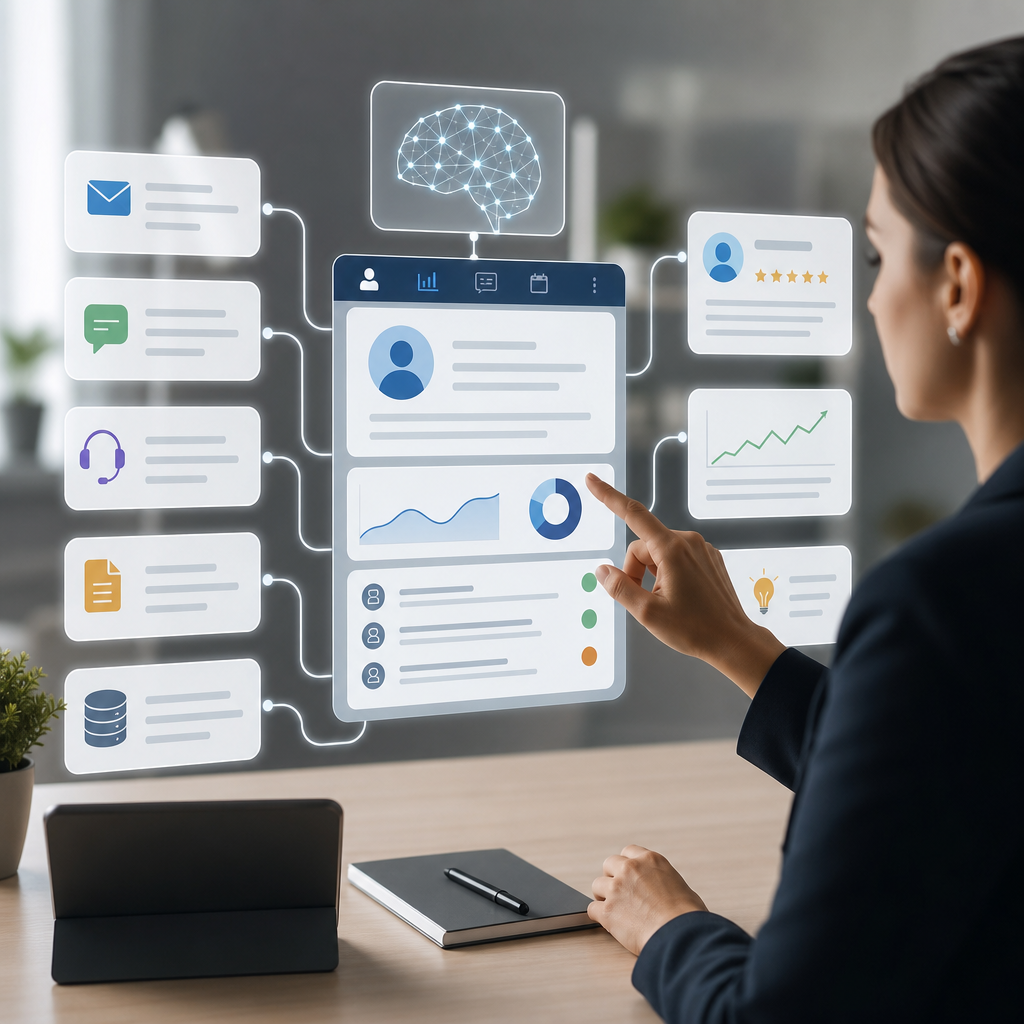
Here’s what that means practically: When your sales rep opens a customer record, instead of scrolling through fragmented notes, the system instantly retrieves relevant context from across your entire business. If the prospect mentioned needing integration with Shopify in a call transcript, referenced inventory management pain in an email, and previously purchased a different product, RAG pulls all of that together and presents a coherent picture. The system understands what matters, in what order, for this specific opportunity right now.
Traditional automation rules (if X, then Y) are rigid. RAG-enabled systems are adaptive. They learn what kinds of information matter for different customer segments, industries, and deal stages. Over time, your CRM becomes smarter about prioritizing what’s actually relevant versus what’s just noise.
The business impact is substantial:
- Sales cycles compress because reps spend less time investigating and more time selling
- Deal quality improves because decisions are based on complete context, not fragmented memory
- Upsell and cross-sell opportunities surface automatically instead of being missed
- New team members achieve productivity faster because the system bridges the knowledge gap
- Customer support becomes proactive because the system connects dots across support tickets, purchasing history, and account health
We’ve seen growing businesses cut deal discovery time by 40-50% after implementing RAG-enabled systems, which means faster cash flow and more capacity for your team to focus on strategic relationships.
How We Build RAG-Enhanced Systems That Learn From Your Data
Our approach starts with understanding your data landscape, not building a generic template. Every business has knowledge locked in different places: CRM records, email archives, support tickets, spreadsheets, past proposals, Slack conversations. The first step is mapping what exists and where it lives.
Next, we identify which data sources will actually improve decision-making. Not everything needs to be connected. A RAG system works best when it’s trained on high-signal information: customer communications, transaction history, support interactions, and project outcomes. We filter out the noise and structure the useful stuff.
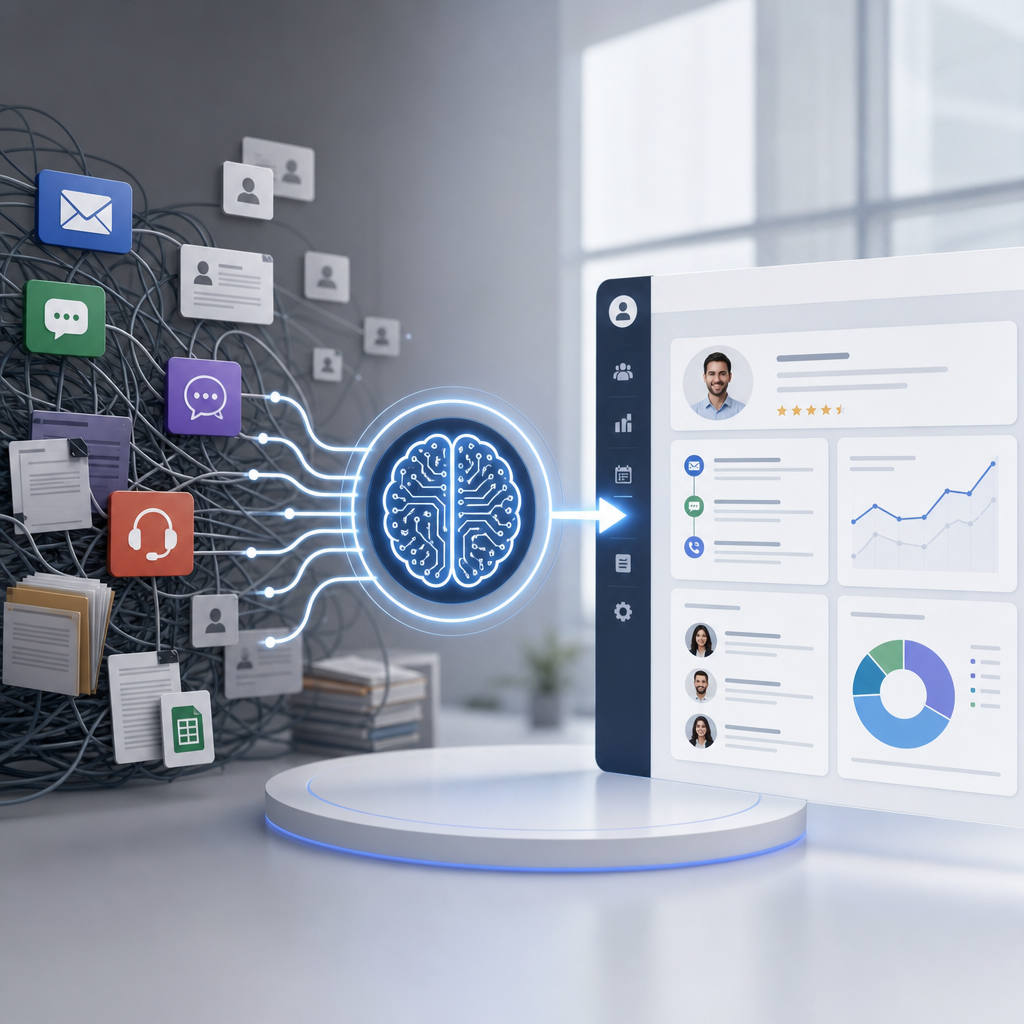
Then we build the retrieval layer. This is where we configure what the system should “know” to look for when a rep interacts with a customer. For a SaaS company, this might be product usage patterns, feature requests, and support sentiment. For a services firm, it’s project scope, timeline performance, and stakeholder preferences. For e-commerce, it’s purchase frequency, category affinity, and lifetime value trends.
The generation layer comes next. This is where RAG transforms retrieved information into actionable intelligence. Instead of presenting raw data, the system synthesizes it: “This customer has purchased quarterly for 18 months, their last request mentioned scaling up operations, and they’re not using three premium features they’re paying for. Recommend a strategic review call focused on ROI optimization.”
Throughout development, we run continuous testing to ensure the system’s suggestions are accurate and useful. Bad recommendations erode trust faster than no recommendations at all. We measure accuracy, relevance, and adoption before we hand over the keys.
What we’re building isn’t a black box. Our RAG-enabled systems include clear visibility into why the system made a recommendation, so your team trusts the intelligence and can refine it over time.
Real-Time Customer Intelligence Without Manual Data Entry
One of the biggest burdens in CRM usage is data maintenance. Your team is supposed to update customer records constantly, but reality intervenes. Calls don’t get logged. Notes stay in notebooks instead of the system. Information ages faster than it can be entered.
RAG-enabled systems flip this dynamic. Instead of your team feeding the system, the system feeds on data that’s already being created. Every email sent to a customer address gets indexed. Support ticket metadata automatically enriches the account record. Slack mentions of specific customers become context signals. Calls can be transcribed and analyzed for sentiment and key discussion points.
This isn’t surveillance; it’s intelligent information harvesting. You define what should be captured and indexed, and the system does the work that would otherwise fall on your team.
The practical result: Your CRM stays current without adding to anybody’s workload. When your rep logs in tomorrow, they see accurate information reflecting conversations from yesterday. Trends become visible in real time instead of in quarterly reviews. Early warning signs of churn surface before customers go quiet. Buying signals get noticed while they’re hot.
For scaling teams, this is transformational. You’re not hiring a data analyst to keep records clean; you’re letting intelligent systems maintain data quality in the background while your team focuses on revenue-generating work.
Scaling Your Team’s Capacity Without Scaling Headcount
Fragmented systems force you to hire more people to manage the complexity. You need someone to own lead qualification. Someone else manages CRM data. Another person coordinates between sales and support. Each new system adds an invisible tax: operational overhead that doesn’t directly contribute to revenue.
RAG-enabled CRM systems compress this overhead dramatically. When the system understands your customers deeply, fewer hands are needed to manage the flow of information and prioritization.
Consider a concrete scenario: Your sales team grows from five to fifteen people. In a traditional setup, you’d likely add a sales operations role or two just to manage data quality, lead routing, and reporting. With RAG intelligence built into your CRM, your existing operations person can handle the expanded team because:
- Lead routing is automated based on account intelligence and rep capacity, not manual assignment
- Deal scoring reflects actual customer context, not generic stage progression
- Rep performance feedback surfaces automatically, eliminating time-consuming manual analysis
- Onboarding is self-service; new reps have instant access to account context and playbooks
Your team still grows, but the ratio of value creators to coordinators stays favorable. That’s real leverage.
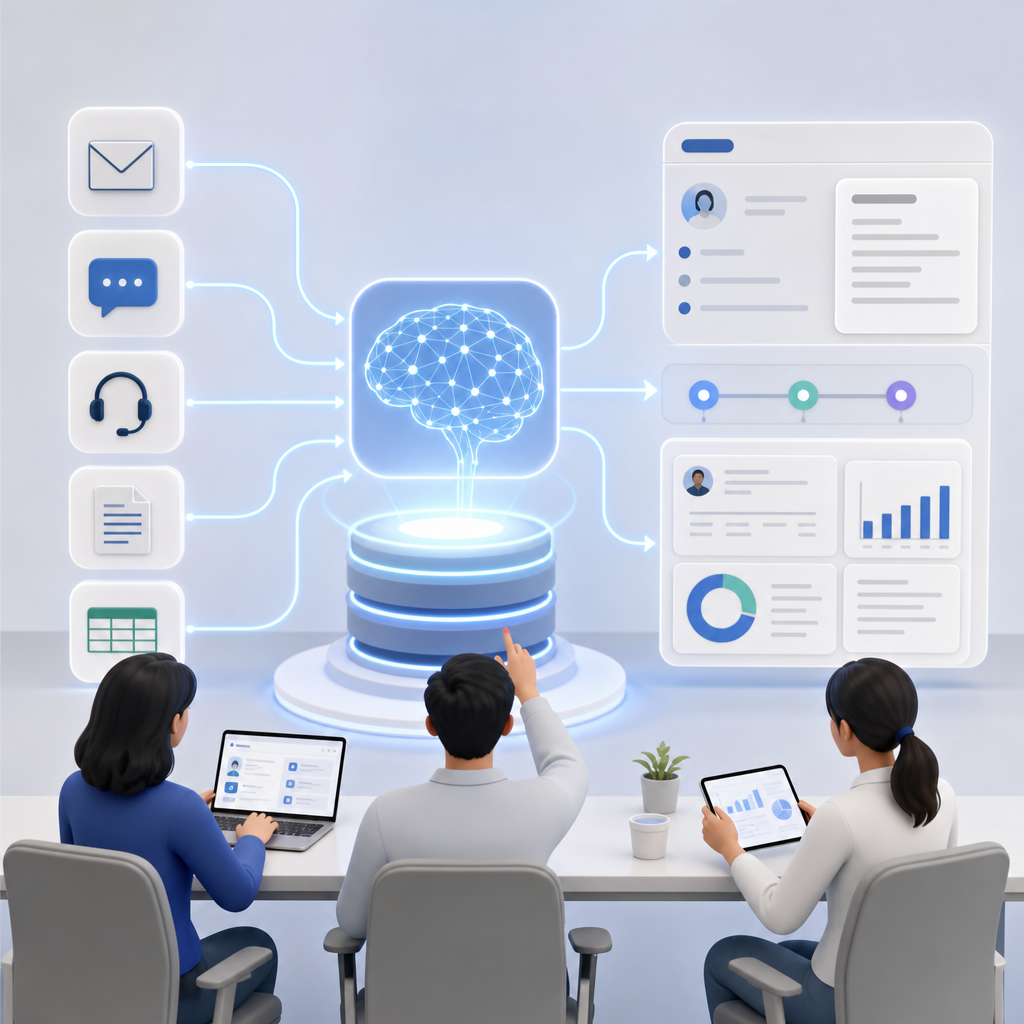
We typically see teams redirect 10-15 hours per week that was spent on manual data management toward actual customer engagement and strategy. Over a year, that’s 520-780 hours reclaimed. Across a growing team, that’s essentially one full-time person’s worth of capacity that you didn’t have to hire for.
Integration: Connecting RAG to Your Existing Business Tools
Your CRM doesn’t operate in isolation. It needs to sync with your email, billing system, support platform, marketing automation, and whatever else runs your business. Poor integrations create silos. RAG intelligence requires access to the full picture.
We build our systems to connect with the tools already in your stack. This means:
- Your email provider feeds communication history into the RAG index without requiring reps to manually log interactions
- Billing and usage data from your payment processor automatically updates account health scoring
- Support tickets from Zendesk, Intercom, or Freshdesk become part of the customer context your reps see
- Marketing automation platforms sync lead quality scores and engagement history
- Accounting software provides transaction context that informs relationship health assessment
Integration isn’t just plumbing; it’s how the system becomes more intelligent. Each connected data source makes the RAG retrieval smarter and more contextual.
We handle the technical complexity so your team doesn’t have to maintain a patchwork of manual syncs and brittle APIs. When you add a new tool, we extend the RAG system’s knowledge base to include it, keeping your intelligence layer current.
Measuring Impact: Performance Dashboards That Matter
You can’t improve what you don’t measure. We build analytics dashboards that show the real business impact of your RAG-enabled CRM, not just vanity metrics.
The metrics that actually matter:
- Deal cycle time: How much faster are deals moving from opportunity to close?
- Rep productivity: Are your team members closing more deals per month with less effort?
- Forecast accuracy: Does your pipeline prediction align with actual outcomes?
- Churn signals: How many at-risk customers are identified automatically versus discovered by accident?
- Time to first value: For new reps, how quickly do they reach productivity benchmarks?
Beyond the surface numbers, we track adoption and trust metrics. If your team isn’t using the system’s intelligence, the ROI drops. We monitor which recommendations are acted on, which are ignored, and where the system might be noisy. This feedback loop helps us refine the RAG training over time so the system gets smarter and more trusted.
Most importantly, we tie these metrics back to revenue impact. How much incremental ARR came from faster sales cycles? How much churn reduction came from early warning systems? We don’t just show activity; we show dollars.
From Implementation to ROI: Our Development Process
Our engagement model is designed for business owners focused on execution, not IT projects. We move quickly and measure constantly.
The process looks like this:
- Discovery and strategy (2-3 weeks). We map your data landscape, identify key customer insight opportunities, and define success metrics. We’re not designing in a vacuum; we’re solving specific problems you’ve identified.
- MVP development (6-8 weeks). We build the core RAG system with your highest-value data sources connected. This isn’t everything; it’s the 20% of features that will drive 80% of the value. We want you using and refining the system as we build.
- Testing and refinement (3-4 weeks). Real users interact with real customer data. The system makes recommendations, your team provides feedback, and we tune the model. We’re measuring accuracy and trust building simultaneously.
- Full deployment and scaling (2-3 weeks). We connect the remaining data sources, train your team, and move the system into production across your entire workflow.
- Ongoing optimization (ongoing). We monitor system performance, gather feedback from daily usage, and continuously improve the intelligence layer. Your RAG system gets smarter as it processes more data and learns from real-world interactions.
Throughout the process, we’re transparent about progress and realistic about timelines. Our goal is to get you measurable results quickly so you can see the value before we’ve even completed the full build.
Why RAG-Enabled CRM Beats Traditional Automation
Traditional automation is deterministic: it follows rules you’ve explicitly defined. If a customer has spent $10,000 in the last year, mark them as high-value. If they haven’t opened an email in 30 days, flag for engagement. It works, but it’s rigid and brittle.
RAG-enabled systems operate differently. They understand nuance. A customer might have low spend but high potential based on industry, company size, and recent conversations about expansion. Another customer might have low engagement in email but high engagement in product usage. RAG captures these patterns and adjusts recommendations accordingly.
Traditional systems also require constant manual tuning. As your business changes, you’re back in the rule engine adjusting thresholds. RAG systems adapt. They learn what patterns correlate with good outcomes and automatically evolve their recommendations.
The other critical difference is context synthesis. Traditional automation sees one dimension at a time. RAG sees the whole picture. A prospect’s previous support interaction, their latest email mention of a pain point, their competitor’s recent feature announcement, and their budget cycle timeline all combine to suggest the exact right moment and angle for outreach. No traditional rule set can capture that complexity.
For scaling teams, this difference is consequential. You’re not just automating tasks, you’re automating intelligence. Your system gets smarter as it works, and that intelligence compounds.
RAG-enabled CRM development is not a technology project; it’s a business transformation project. It’s about moving from a system that stores information to a system that understands your customers and helps your team make better decisions faster.
If you’re ready to move beyond fragmented data and rigid automation, let’s talk about what RAG intelligence could unlock for your business. We’ve built these systems for scaling operators across SaaS, services, and commerce, and the pattern is consistent: the businesses that systematize customer intelligence grow faster and more predictably than those still managing customer relationships manually.
Your next step is a strategic conversation about your data landscape and your specific growth constraints. We’ll show you exactly where RAG-enabled CRM would create the most impact for your team and bottom line.