
The Lead Qualification Bottleneck Every Small Sales Team Faces
Your sales team is drowning in inbound inquiries. Some are hot prospects ready to buy. Others are tire-kickers, students doing research, or competitors gathering intelligence. Your team spends hours sorting through them, asking the same qualifying questions over email or phone, only to discover half the leads don’t fit your ideal customer profile.
This is the lead qualification bottleneck, and it’s costing you revenue in two ways. First, your sales reps are spending time on administrative triage instead of closing qualified deals. Second, prospects who genuinely want to buy are sitting in a queue waiting for a callback, and your competitors aren’t.
Most small to mid-sized businesses handle qualification manually because they haven’t had the infrastructure to do it differently. A prospect fills out a form, someone on the team reviews it, then either schedules a call or sends a rejection email. If your business processes $2M to $50M+ in annual revenue and is actively scaling, this manual approach becomes your growth ceiling. You can’t hire sales reps fast enough to keep pace with inbound demand, and the ones you do have spend 20-30% of their time on qualification work that doesn’t close deals.
The bottleneck exists because qualification requires consistency, availability, and context. You need the same questions asked the same way to every lead, 24 hours a day, even when your team is sleeping. You need instant feedback on whether a prospect is worth a sales call. And you need all of that tied directly to your CRM so nothing gets lost in handoff.
Why Manual Lead Qualification Costs You Revenue
The math on manual qualification is brutal once you look closely. A sales representative earns roughly $80,000 to $150,000 annually depending on seniority and industry. If they spend 5-7 hours per week on qualification work (and most do), that’s 260-360 hours annually dedicated to asking, “What’s your budget?” and “What’s your timeline?” You’re paying $20,000 to $30,000 per year just to sort leads that a system could handle automatically.
But the financial impact goes deeper than labor cost. When leads wait for qualification, they lose momentum. A prospect who fills out a form at 2 p.m. on a Friday and doesn’t hear back until Monday morning has already moved on. Studies consistently show that response time to inbound leads is one of the strongest predictors of conversion. A 5-minute response beats a 1-hour response by 100x. Manual qualification can’t match that speed.
There’s also the quality problem. Humans get tired, distracted, or distracted by high-priority deals. A junior team member might let a marginal lead through to close because they’re overworked. Or a good prospect might slip through because they asked their questions differently than the standard script. Manual processes introduce variability, and variability in qualification creates noise downstream for your entire sales pipeline.
Consider a concrete scenario: You run a software company with 3 sales reps. You get 100 inbound leads per month. Your team spends 40 hours manually reviewing and qualifying them. That’s roughly 4 hours per rep per week on qualification alone. At $40 per hour all-in cost (salary plus overhead), you’re spending $160 per lead just to figure out whether it’s worth talking to. If your average deal value is $50,000, that’s 0.32% of deal value spent just deciding which deals to pursue. More importantly, 30-40% of those leads never connect with your team because they arrive outside business hours or get deprioritized when something urgent comes up.
Automated lead qualification removes these friction points. It’s available instantly, asks consistent questions, never gets distracted, and integrates directly with your CRM. The result is faster handoffs to sales, fewer lost prospects, and more closed deals per rep.
How AI Chatbots Qualify Leads in Real Time
An AI chatbot qualification system works like a smart receptionist that never sleeps. When a prospect lands on your website, fills out a form, or initiates a chat, the bot engages immediately. It asks pre-programmed qualifying questions in a natural, conversational way, gathers responses, and scores the lead in real time based on fit.
The key difference between a basic chatbot and an intelligent qualification system is sophistication. A basic bot might just collect email and phone number. A qualification bot understands context and intent. It knows the difference between a question that indicates genuine buying interest and one that signals “just browsing.” It can pick up on budget constraints, timeline urgency, and whether the prospect is in your ideal customer profile.
Here’s what happens behind the scenes. Your AI chatbot asks open-ended questions like, “What challenge brought you here today?” and “How soon are you looking to solve this?” The bot analyzes the response using natural language processing to extract key data points: urgency, problem fit, budget signals, and authority. Based on your predefined qualification criteria, the system assigns a lead score (perhaps 1-100) and a decision: “route to sales immediately,” “nurture for 30 days,” or “not a fit, send resources instead.”

All of this happens in seconds. The prospect gets an immediate response, feels heard, and moves forward in your funnel. Your sales team sees a pre-qualified lead with context already gathered, so they can jump straight into a consultative conversation instead of repeating qualification questions.
The real power emerges when your AI qualification system connects to your CRM. Every response is logged. Every interaction is timestamped. Every lead score feeds into your sales pipeline analytics. Your team can see at a glance which prospects are hot, which are warm, and which are educational interest only. You’re no longer flying blind.
Building Your AI Qualification System: The Right Questions Matter
Not all questions qualify leads equally. The foundation of an effective qualification system is asking the right questions in the right order, and we’ve learned this through building dozens of AI chatbots for scaling businesses.
Start by defining your disqualifying criteria. What instantly makes someone not a fit? For a B2B SaaS company, this might be: “They don’t have a team.” For a software implementation partner, it might be: “They’re using a competing platform we can’t integrate with.” For a professional services firm, it might be: “They’re looking for a one-time project, not ongoing support.” Identify 2-3 hard disqualifiers and lead with them.
Next, map your buying journey and identify the data you actually need to predict close probability. Most businesses think they need 15 qualifying questions. They really need 4-5. Your bot should ask about:
- Problem fit: “Does this prospect have the pain point we solve?”
- Authority: “Can they make or influence the buying decision?”
- Timeline: “When do they need to solve this?”
- Budget: “Do they have resources allocated?”
- Fit: “Are they in our ideal customer segment by company size, industry, or use case?”
Order matters. Ask about timeline before budget. Ask about authority before budget. Budget is sensitive, so leave it for mid-conversation when rapport is building. Open with something that lets the prospect talk about their challenge. People like being heard. A bot that starts with “What’s your company size?” feels impersonal. A bot that starts with “What brought you here today?” feels conversational.
Use conditional logic to branch the conversation. If someone says they’re looking to solve a problem in the next 30 days, ask more about their buying process. If they say 6-12 months, acknowledge it and still capture them for nurture. If they say they don’t have budget allocated, that’s not a disqualifier forever, just a “not now” that feeds into nurture workflows.
One actionable step: Map out your top 5 qualified deals from the last year. Reverse engineer what they all had in common: timeline, company size, industry vertical, problem statement. Now design your bot’s questions to surface those exact attributes. You’re not trying to build a universal lead scorer; you’re building one tuned to your actual customer profile.
Integrating AI Chatbots Into Your Existing Sales Funnel
Your AI qualification system doesn’t replace your funnel. It sits at the top of it, acting as the first filter and the data engine that feeds everything downstream.
Most businesses today use a combination of channels: website forms, email, social media inquiries, phone calls, and integrations with ad platforms like Google Ads or LinkedIn. A centralized AI qualification layer can handle conversations across these channels. A prospect reaches out via website form; the bot engages. The same prospect might later message via SMS or WhatsApp; the bot continues the conversation with full context because it’s pulling from the same data store.
The integration architecture is straightforward. Your qualification metrics and lead scoring feed directly into your CRM. When a lead hits a certain score threshold, it’s automatically assigned to the right sales rep, added to a nurture sequence if not ready, or sent a resource if it’s not a fit. This eliminates manual triage entirely.
Here’s a practical implementation flow:
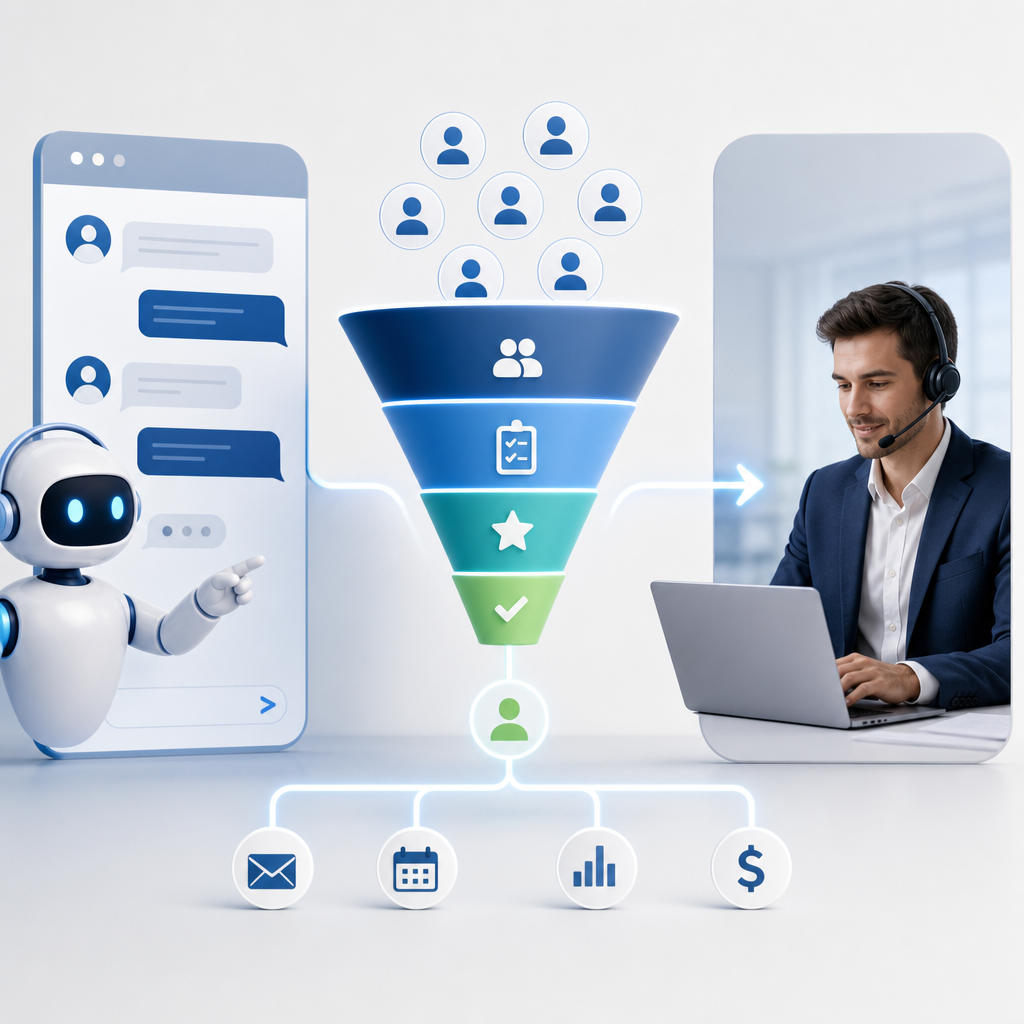
- Prospect initiates contact through any channel.
- AI bot engages, asks qualifying questions, gathers responses.
- Lead is scored and segmented (hot, warm, cold, not a fit).
- Hot leads are routed to the next available rep with context pre-loaded in the CRM.
- Warm leads enter a nurture automation sequence (email, content, retargeting).
- Cold leads are engaged with educational content and marked for follow-up after 30-45 days.
- Not-a-fit leads receive a helpful response and are offered resources or referral options.
The key integration challenge most teams face is data consistency. If your chatbot data doesn’t sync cleanly to your CRM, you’ll end up with duplicate records, incomplete data, and reps who can’t see qualification notes. This is why we always recommend using CRM-native integrations or API-first platforms that are built for bi-directional sync. Your chatbot should pull company information from your CRM so it can personalize conversations. Your CRM should receive bot data in real-time, not in batch uploads that happen once daily.
One more consideration: your sales team needs to understand the lead score. If a rep sees a score of 72 but doesn’t know why, they won’t trust it. Build a simple legend in your CRM that explains what each score range means and what actions you expect. A 80+ might mean “call within 1 hour.” A 60-79 might mean “call within 24 hours.” A 40-59 might mean “add to a nurture sequence and follow up after 7 days.”
From Bot Interaction to Sales Handoff: Creating Smooth Workflows
The handoff from chatbot to sales rep is where most automation systems fail. The bot collects good data, but the sales rep doesn’t see it, or the prospect feels abandoned by the transition.
A smooth handoff has three components: context, timing, and continuity.
Context means the sales rep knows exactly what the bot learned about the prospect. Instead of opening a call saying, “Hi, can you tell me a bit about your situation?” they’re saying, “I saw you’re looking to solve this by Q2. Can you walk me through what your current process looks like?” That’s a completely different conversation. The prospect feels understood and respected; the rep skips qualification and goes straight to solution fit.
The way to deliver context is through a structured handoff note in your CRM that pulls the bot’s findings into a human-readable summary. Something like:
Lead Score: 78 (Hot) Timeline: 30-60 days Key Challenge: Current system is manual, losing 10+ hours per week Budget: Allocated Authority: VP making decision, needs CFO approval Next Step: Discuss integration with existing tools
Timing is about not making the prospect wait. The bot should offer to schedule a call with a rep immediately if the lead is qualified. If your team is available, that call should happen within 5 minutes. If not, offer a specific time (“I can connect you with Sarah at 2 p.m. today”) instead of a vague “someone will reach out.” Some businesses use AI voicebot handoffs where the prospect stays on a call and is transferred to a human rep without repeating information. That’s the gold standard of experience.
Continuity means the sales rep acknowledges the bot conversation and references it. “I see our assistant already asked about your timeline. Let’s dig into the budget side now.” This tells the prospect that information wasn’t lost in translation. It feels like one continuous conversation, not a restart.
Set up your CRM to automatically alert reps when a hot lead is ready for handoff. Don’t rely on people checking dashboards. Integrations with Slack, Teams, or email ensure reps see qualified leads immediately. And track the time between bot interaction and sales contact. If it’s taking 2+ hours on average, you have a fulfillment problem.
Measuring What Matters: Tracking Qualification Metrics That Drive Revenue
You can’t optimize what you don’t measure. The mistake most teams make is tracking activity metrics instead of outcome metrics.
Activity metrics feel productive but don’t predict revenue. “We qualified 200 leads this month” sounds good until you realize only 5 turned into customers. Outcome metrics are the ones that matter: lead-to-customer conversion rate, average deal size for bot-qualified vs. manually-qualified leads, time from qualification to close, and cost per qualified lead.

Here are the core metrics you need:
Lead Quality Score: Compare bot-qualified leads to your historical average conversion rate. If your manually-qualified leads convert at 8% and your bot-qualified leads convert at 12%, you’ve found a winning system worth doubling down on. Track this by qualification source to identify which questions are the best predictors of fit.
Qualification-to-Sales Handoff Time: This is the time between when a bot finishes qualifying and when a rep initiates contact. Your target should be under 15 minutes for hot leads. If you’re hitting 4+ hours, prospects are cooling off.
Cost Per Qualified Lead: Divide your total qualification labor and system cost by the number of leads that hit your qualification threshold. Compare this to your CRM cost per lead. Most teams find that AI qualification drops CPQL by 40-60% because fewer people hours are involved.
Bot Engagement Rate: What percentage of prospects that interact with your bot complete the qualification questions? If you’re seeing drop-off, your questions are either too aggressive or unclear. A/B test your bot conversation flows to improve completion rates.
Lead Score Accuracy: 90 days after your bot assigns a score, look back and see how predictive it was. Did leads scored 70+ close at a higher rate than leads scored 40-50? If not, your scoring model needs recalibration.
Dashboard reporting is critical here. You and your team need to see these metrics updated daily, not monthly. We recommend analytical dashboards that give you a weekly view of qualification performance, bot conversation trends, and the pipeline impact. When you can see that bot-qualified leads are closing 2x faster than manual ones, your whole team believes in the system.
One practical detail: tie bot performance to team incentives. If your sales reps know that leads tagged “hot” by the bot have a 15% close rate versus 5% for cold leads, they’ll trust and prioritize those leads. Transparency drives adoption.
Getting Started With AI Lead Qualification Today
You don’t need perfect. You need to start.
The first step is audit what qualification work you’re currently doing manually. For one week, track how much time your sales team spends asking qualifying questions, sorting leads, and responding to prospects. Calculate the labor cost. Most teams are shocked to find it’s $3,000-$8,000 per month per rep. That’s your ROI case right there.
Next, document your actual qualifying criteria. Sit down with your sales leadership and ask: “What do the deals we close have in common?” Write down 3-5 non-negotiable attributes (company size, industry vertical, problem type, budget level, etc.). These become your bot’s scoring model.
Then choose your first channel to automate. Don’t try to cover email, SMS, web chat, and social media at once. Start with your website form. Set up an AI chatbot that engages new website visitors and asks your predefined qualifying questions. Connect it to your CRM. Run it for 30 days and track conversion rates and rep feedback.
From there, expand gradually. Add SMS qualification for people who fill out forms but don’t have time for a chat. Build an AI voicebot that can call prospects and qualify them using voice (this is surprisingly effective for B2B). Integrate with your paid ad platforms so leads from Google and LinkedIn get immediate qualification.
The implementation timeline matters less than consistency. A basic chatbot deployed and optimized beats a perfect system that’s six months away from launch. We help scaling businesses move from manual, fragmented qualification to AI-powered systems that handle the routine while your team handles the close. The typical deployment takes 2-4 weeks, and we’ve seen clients report 40%+ reduction in qualification time and 25%+ improvement in lead-to-customer conversion within the first 90 days.
Start now. Document your current process, identify your qualifying questions, pick one channel, and deploy. The alternative is watching your sales team spend the next year asking the same questions over and over, one lead at a time.