
Why Fragmented Tools Are Killing Your Growth
Most scaling operators run their business on a disconnected stack. Your website lives on one platform. Your CRM data sits in another. Lead capture happens through a third tool. Your email automation runs on a fourth. The result: data silos, manual handoffs, and lost opportunities.
When systems don’t talk to each other, information falls through cracks. A prospect fills out a form on your website, but that data doesn’t automatically populate your CRM. Your sales team manually enters the lead into three different places. By the time anyone follows up, the buyer has already moved on to a competitor who responded faster.
The real cost isn’t just wasted time. It’s visibility blindness. You can’t see the full customer journey because your data is fragmented. You don’t know which marketing channels actually convert because lead sources aren’t properly tracked. You can’t predict revenue because your pipeline data is incomplete or inconsistent across systems.
When we work with scaling businesses, we see this pattern repeatedly: companies with $5M to $50M+ in annual revenue operating with the efficiency of much smaller teams. The tools aren’t the problem. The problem is that tools aren’t integrated.
Takeaway: A unified platform reveals the real story of your customer acquisition and conversion. Fragmented systems hide it.
The Cost of Juggling Multiple Platforms
Let’s get specific about what fragmentation actually costs you in dollars and time.
Consider a typical mid-market sales operation. You have seven people on the team: sales reps, coordinators, and management. Each rep spends roughly 45 minutes every day entering data into multiple systems, sending manual emails that should be automated, and hunting for information that should be readily accessible. That’s nearly 4 hours per person per week. For a seven-person team, that’s 28 hours of productive selling time lost every week to administrative work.
At a fully-loaded cost of $75 per hour, that’s $2,100 per week, or roughly $109,000 per year in pure waste.
But the hidden costs are worse:
- Lead response lag: When leads aren’t automatically routed to the right rep, your first response time extends from minutes to hours. Studies show that answering within one minute is 21 times more likely to result in a qualified conversation. Fragmented systems make speed impossible.
- Data inconsistency: Different teams update the same prospect information in different places. Your marketing team sees a contact as “unqualified.” Your sales team marks them as “nurture.” Your SDR team doesn’t know they’ve already been contacted. You waste budget retargeting the same person on three different platforms.
- Missed automation opportunities: Without integration, you can’t automate workflows that depend on cross-platform triggers. For example: “When a contact reaches a certain engagement score in our marketing automation platform, instantly flag them as sales-ready in the CRM and alert the assigned rep.” These automations require integration to work.
- Reporting gaps: You can’t build a cohesive dashboard. Executives ask, “How many leads did we generate last month?” and the answer requires pulling data from five different sources and reconciling it manually.
The companies we work with typically recover 20-40% of lost productivity within the first 90 days of consolidating to an integrated platform. That translates directly to more leads worked, faster conversion cycles, and higher close rates.
Takeaway: Fragmented systems don’t just waste time; they cost you revenue through slower response times, missed follow-ups, and lost automation opportunities.
What Full-Stack Web Development Plus CRM Actually Means
When we talk about full-stack web development plus CRM, we’re describing something more intentional than just “building a website and adding a CRM.”
Full-stack web development means we build your entire digital presence from the ground up: front-end design and user experience, back-end infrastructure and databases, server logic, API integrations, and deployment. We don’t use off-the-shelf templates. We build your platform to your actual business requirements.
Add CRM to that foundation, and you get something different. Instead of bolting a CRM onto a website, we build CRM intelligence directly into your web platform. Every interaction a prospect has with your website is tracked, scored, and synchronized to your customer database in real time.
Here’s what integrated means in practice:
- Lead capture feeds directly into workflows: A prospect fills out a form. That data instantly populates your CRM, triggers an automated response, and alerts the right sales rep based on assignment rules you’ve defined.
- Website behavior informs sales strategy: Your platform tracks which pages a prospect visits, how long they spend on each, which resources they download, and what actions they take. That behavioral data automatically updates their lead score in the CRM.
- Sales team has context at every touchpoint: When a rep opens a prospect record, they see the complete timeline: which emails were opened, which pages were visited, which content was downloaded, all previous conversations, and recommended next actions based on engagement patterns.

- Automation scales your outreach: Your website becomes a 24/7 sales tool. Welcome sequences, nurture campaigns, and re-engagement workflows all run automatically based on triggers and rules you’ve configured.
This is fundamentally different from the traditional approach of buying tools separately and hoping they integrate. We architect your growth engine from day one with integration as the foundation, not an afterthought.
Takeaway: Unified web development plus CRM means every digital touchpoint automatically feeds intelligence back to your sales system, creating a self-improving sales machine.
How We Build Growth Engines, Not Just Websites
When you partner with us, we don’t start by asking “What should your website look like?” We start with strategy: Where are you in your growth cycle? What’s your ideal customer profile? What are the biggest bottlenecks in your current sales process? What conversion rates are you actually seeing at each stage?
Our approach has four phases:
Phase 1: Growth Architecture We map your entire customer journey and identify the specific points where automation or better data visibility would have the highest impact. We might find that your biggest constraint isn’t traffic; it’s lead quality. Or maybe you’re getting leads but your follow-up process is inconsistent. We quantify the problem before we build.
Phase 2: Platform Design Based on the strategy, we design your integrated platform. This includes website architecture, CRM structure, automation workflows, and reporting dashboards. Everything is connected from the ground up. We use best-in-class technologies and ensure scalability from day one, so you’re not rebuilding in two years.
Phase 3: Development & Integration Our development team builds your platform and integrates it with your existing tools (payment processors, email platforms, analytics, advertising accounts). We use APIs to ensure data flows seamlessly in both directions.
Phase 4: Optimization & Training We deploy your platform, train your team, and spend the first 30-60 days measuring and optimizing performance. We’re not handing you a website and walking away. We’re proving that it works and helping you extract the most value from it.
Throughout this process, we’re focused on measurable outcomes: lead volume, lead quality, response time, conversion rate, and revenue generated. If a feature doesn’t move one of these metrics, it doesn’t get built.
Our Design and Development process is built around this growth-first philosophy. We’re not just creating something that looks good; we’re building something that converts.
Takeaway: A true growth engine starts with strategy, not design. We architect your platform around your actual bottlenecks and revenue drivers.
Real Results: How Our Unified Approach Generates 15+ Leads in 30 Days
Results matter more than theory. Here’s what we’re seeing with our clients using integrated platforms.
One client, a B2B services company with $8M in ARR, was generating about 20-25 leads per month from their website. The leads were lower quality, and the sales team was spending significant time on follow-up. After implementing a unified web platform with integrated CRM and automated workflows, they increased to 40-50 qualified leads per month within 60 days.
What changed? Several things:
- Better lead capture: We rebuilt their website with dynamic forms that showed different content based on visitor behavior. A visitor in the “awareness” stage would see educational content. A visitor showing high engagement would be presented with a consultation offer. This segmentation improved lead quality and quantity.
- Automated nurture: Cold leads that weren’t ready to talk to sales entered an automated nurture sequence. The platform tracked their engagement and automatically escalated them to sales when they showed buying signals. The sales team wasn’t wasting time on unqualified prospects; they were focusing only on high-probability conversations.
- Lead scoring: Every interaction a prospect had with the website or emails updated their score in the CRM. Sales reps knew exactly which leads were hottest and should be prioritized.
- Response speed: When a new lead came in, they received an immediate automated response with relevant next steps, and the assigned rep was notified instantly. Average response time dropped from 8 hours to 3 minutes.
Another client, a professional services firm, was struggling with lead quality. They had good traffic but a 2% conversion rate. After integrating their website with a properly configured CRM that included qualification workflows, their conversion rate improved to 5.2% within 90 days. Same traffic. Better results.
We guarantee 10+ qualified leads in 30 days when we implement our integrated approach for companies with sufficient traffic or marketing reach. This isn’t hypothetical. It’s what we consistently deliver.
Takeaway: Unified platforms consistently improve lead volume and quality because they eliminate friction, automate low-value tasks, and enable sales teams to focus on high-impact activities.
Custom CRM Integration Built Into Your Web Platform
Traditional CRM implementations are painful because they’re bolted onto existing processes. Teams resist using them because they create more work, not less. Integration changes that dynamic entirely.
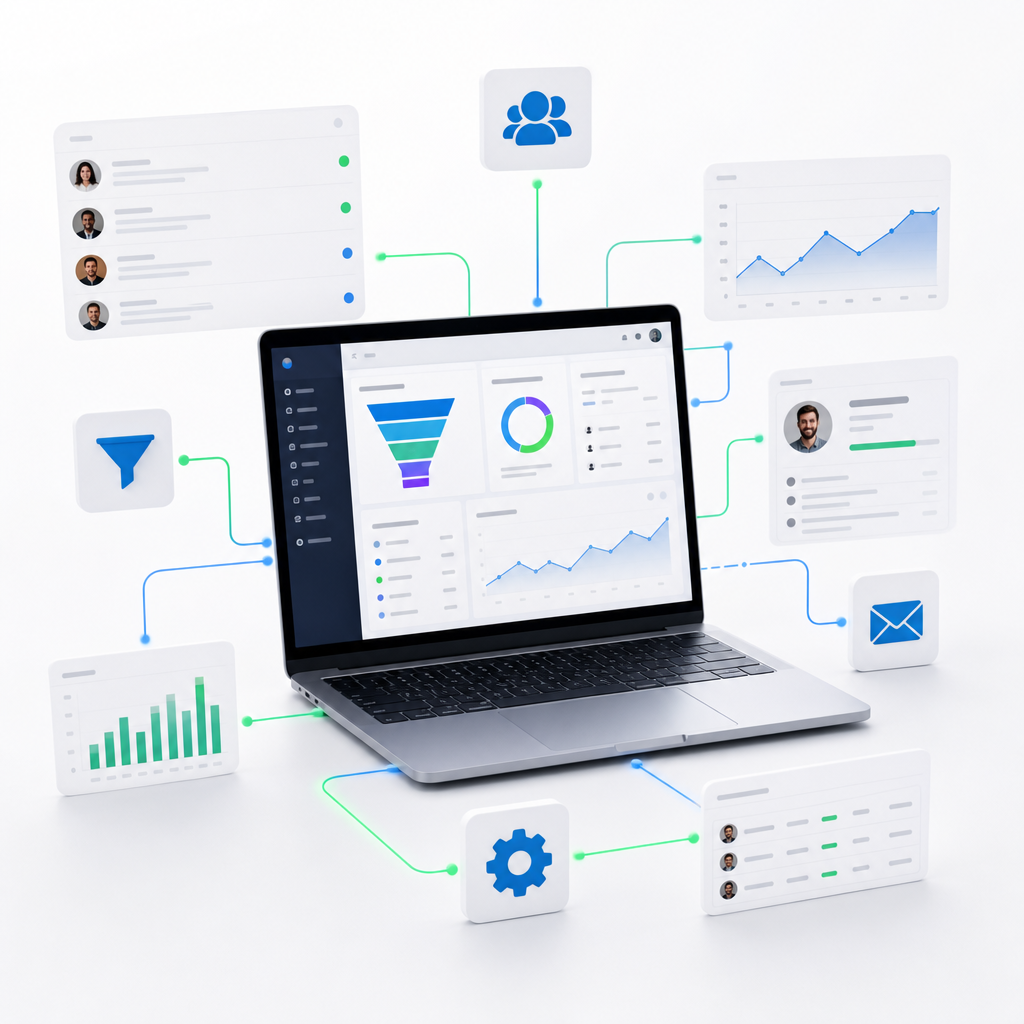
When we build your CRM as part of your web platform, not separate from it, everything becomes easier:
Your website automatically qualifies leads. Instead of your sales team manually scoring every inbound inquiry, your website is doing the heavy lifting. A prospect answers a few qualification questions or takes certain actions, and the platform automatically determines if they fit your ideal customer profile.
Your sales team enters data once. When a rep logs into their CRM to view a prospect, they see everything: all communications, all website interactions, all previous history. They don’t need to hunt through three different tools to get context.
Every system talks to every other system. When you close a deal in your CRM, it automatically triggers an invoice in your accounting system and sends a welcome email from your email platform. When a customer changes their information in your self-service portal, it updates immediately in your CRM. No manual syncing. No data inconsistency.
Reporting becomes strategic, not manual. With integrated data, your dashboards are real and current. You know exactly how many leads each marketing channel is generating, how those leads are converting through your sales process, and which customers are most profitable. These insights guide better decisions.
We’ve built CRM integration into platforms for companies across industries: SaaS, professional services, e-commerce, B2B agencies, coaching and consulting. The underlying principle is the same: integration reduces friction and accelerates growth.
Takeaway: CRM works best when it’s built into your core platform, not layered on top. Integration eliminates manual data entry and enables real-time visibility across your entire business.
AI Automation: Where Your Website Becomes Your Salesman
Here’s where integration unlocks something truly powerful: AI automation that turns your website into an active salesman.
Your website currently passively displays information. Visitors come, read, and either convert or leave. With AI automation, your website actively engages.
We implement AI Bots that qualify prospects in real time, answer questions instantly, and book meetings automatically. These aren’t simple chatbots that respond to keywords. They’re intelligent systems trained on your business knowledge, products, ideal customer profile, and previous successful conversations.
Here’s how it works:
A prospect lands on your website. Instead of searching through pages, they engage with your AI bot. The bot asks clarifying questions, understands the prospect’s situation, and either:
- Routes them to relevant content if they need more information
- Answers their specific question using your product knowledge base
- Qualifies them and offers to book a meeting with a human sales rep
The bot’s conversation is logged in your CRM. When the prospect eventually talks to a sales rep, the rep has complete context: what the bot discussed, what the prospect was looking for, and what their likely objections might be.
Meanwhile, the bot continues to engage prospects when your sales team is offline. At 2 AM, a prospect has a question. They get an instant, intelligent response rather than having to wait until business hours. This speed creates competitive advantage.
We’ve seen clients increase their lead volume by 25-35% simply by adding AI automation to their platforms. The bot handles high-volume, low-complexity inquiries, freeing your sales team to focus on high-value conversations. And because everything is integrated, every bot interaction automatically becomes part of the prospect’s journey in your CRM.
Takeaway: AI automation built into your web platform enables 24/7 lead engagement and qualification, dramatically improving response speed and lead volume without increasing headcount.
Scalability Without the Complexity or Headcount
Most growing companies hit a wall. Traffic increases, lead volume increases, but converting those leads requires proportional increases in headcount. You hire more reps, coaches, and coordinators. Profit margins compress because your cost structure has grown.
An integrated platform breaks that equation. We design systems that scale efficiency, not just volume.
Here’s the difference:
Without integration: You need one rep for every 40-50 prospects they can meaningfully touch. Managing that team requires managers. Managing managers requires directors. Your overhead grows linearly with scale.
With integration: Your platform handles prospect engagement, qualification, nurture, and routing automatically. Your reps focus exclusively on closing conversations and managing relationships. The same rep can now effectively handle 80-100 prospects because they’re not wasting time on administrative tasks or working unqualified leads.
One client increased their monthly lead volume from 30 to 120 (4x) while their sales team grew from 3 reps to 4 reps. That’s 12x growth in deals while headcount increased just 33%. Profit margin actually improved because their cost-per-acquisition decreased and their leverage improved.

We architect your platform with scalability in mind from day one. Your infrastructure can handle 10x growth without rebuilding. Your automation scales instantly. Your team grows only as fast as needed.
This is possible because integration removes the manual work that creates bottlenecks. When everything is connected and automated, your team’s capacity grows with your technology, not independently.
Takeaway: Integrated platforms enable superlinear growth: you can scale revenue dramatically without proportional increases in headcount or operational complexity.
Why US Businesses Are Moving Away from Point Solutions
The market is shifting. Ten years ago, the default approach was to buy the best-in-class tool for each need: HubSpot for CRM, Shopify for e-commerce, ConvertKit for email, Zapier for integration. Piece them together and hope they work.
That approach is becoming obsolete. Here’s why:
Integration debt accumulates. Every new tool you add requires integration with existing tools. After you’re using 7-8 systems, managing those integrations becomes its own job. Your company’s IT person is spending half their time keeping the ecosystem functional rather than strategic.
Data consistency gets harder, not easier. With more disconnected systems, you actually have less reliable data. When systems conflict (which they will), you don’t know which one is authoritative.
Competitive disadvantage compounds. If your competitor has an integrated platform that responds to leads in 2 minutes and yours responds in 4 hours, they’re winning more deals. They’re extracting more value from the same traffic. Eventually, this advantage becomes insurmountable.
The cost of switching gets prohibitive. Once you’re entangled in six different systems, switching to something better becomes almost impossible because of data migration complexity and team disruption.
Smart operators are realizing that an integrated platform designed for growth is worth more than the cheapest tools assembled into a Frankenstein stack. They’re willing to pay slightly more for something that actually works seamlessly.
This is why we’ve seen accelerating momentum toward comprehensive platforms: Salesforce is moving upmarket and adding functionality. Newer companies are building integrated stacks from the ground up. The point-solution era is ending.
Takeaway: The competitive advantage in 2026 goes to companies with integrated platforms, not companies with the most tools. Consolidation beats complexity.
Your Path Forward: From Fragmented to Integrated
If you’re running multiple disconnected systems, you have three choices:
Option 1: Keep the status quo. Accept slower growth, higher operational costs, and competitive disadvantage. This is viable if you’re happy with current trajectory, but most growing operators aren’t.
Option 2: Replace everything with a massive platform migration. Rip out your entire stack and replace it with an all-in-one solution. This is disruptive and risky, but sometimes necessary if you’re using truly incompatible systems.
Option 3: Build an integrated platform intentionally. Start with your highest-impact problem (usually lead capture and qualification), then systematically integrate additional functions. This is lower risk and proves value at each stage.
We typically recommend Option 3 for scaling businesses. Here’s the path:
Month 1-2: Integrated web platform with basic CRM. Build your website and customer database as one system. Start capturing leads directly into your database. Implement basic lead scoring and automated routing.
Month 3: Add automation. Layer in automated workflows that nurture leads, send follow-up emails, and trigger alerts when prospects show buying signals.
Month 4-6: Add AI. Implement AI bot engagement to handle initial qualification and 24/7 prospect interaction.
Month 6+: Optimize and scale. Measure results, identify bottlenecks, and continue improving. At this point, you’re not implementing new tools; you’re perfecting your system.
The entire process takes 4-6 months. Within that timeframe, most clients see 40-60% improvement in lead conversion rate and 25-40% reduction in sales cycle length.
Your next step is straightforward. Identify your single biggest bottleneck: Is it lead volume? Lead quality? Response time? Sales team inefficiency? Closing rate? Pick one. We’ll help you design an integrated solution that addresses it and builds the foundation for everything else.
Growth at scale requires systems that grow with you. Fragmented tools don’t scale. Integrated platforms do.