
The Real Cost of Fragmented Systems and Manual Processes
Most scaling businesses don’t have a revenue problem. They have a systems problem.
We see it constantly: a company with $5M in ARR using spreadsheets to track leads, a separate tool for customer communication, another for billing, and a Rolodex of manual follow-ups that lives in someone’s head. Each system works in isolation. Data doesn’t talk to data. Leads fall through cracks. Sales cycles drag on. Revenue becomes unpredictable.
The hidden cost isn’t what you’re paying for software licenses. It’s what you’re losing in operational efficiency, missed opportunities, and team frustration. When your team spends 10 hours a week moving data between systems, they’re not closing deals. When a lead inquiry sits in an inbox instead of triggering an automated nurture sequence, you’re losing qualified prospects to competitors who move faster.
Our analysis of 200+ growing businesses shows that companies operating on fragmented systems lose an average of 15-20% of potential revenue annually just to process inefficiency and lead leakage. That’s material money left on the table.
The fix isn’t buying more tools. It’s building an integrated system where data flows automatically, decisions are triggered intelligently, and your team focuses on strategy instead of administrative work.
Why Generic CRM Solutions Fail Growing Operators
Salesforce, HubSpot, Pipedrive, and others solve the CRM problem for some businesses. But they’re built for breadth, not depth. They work well when your sales process looks like everyone else’s.
The moment you start scaling with a unique go-to-market strategy, custom pricing models, or multiple revenue streams, off-the-shelf platforms start fighting you. You end up in a frustrating cycle:
- Buying expensive add-ons that mostly work
- Hiring a consultant to customize workflows that should be automatic
- Losing data in integrations between your CRM and accounting, marketing, or fulfillment systems
- Training your team on features they’ll never use while missing the ones you actually need
Generic platforms also assume your customer journey is linear. In reality, complex B2B sales involve multiple touchpoints, stakeholder alignment, proposal reviews, and non-standard deal structures. Off-the-shelf solutions force you to adapt your business to fit the software, not the other way around.
We’ve seen teams waste thousands of hours trying to shoehorn their process into a rigid platform instead of building a system that matches how they actually operate.
How We Build Custom CRM Systems That Drive Qualified Leads
When we build a custom CRM for a scaling operator, we start by understanding your business model, not by selecting templates.
We map your entire customer lifecycle: how leads enter your system, what information qualifies them, what actions your team needs to take, and what triggers the next step. Then we design a CRM architecture that automates the mechanical parts and surfaces the strategic parts where your team adds real value.
A custom CRM we built for a mid-market SaaS company automated lead scoring based on their unique product fit criteria, triggered personalized outreach sequences based on lead source and behavior, and routed qualified opportunities directly to the right sales rep. Their follow-up time dropped from 48 hours to 4 hours.
Key capabilities we build into custom systems:
- Lead capture from multiple sources (web forms, email, API integrations, phone)
- Intelligent lead scoring that reflects your actual sales criteria
- Automated workflows that guide prospects through your funnel without human intervention
- Real-time visibility into pipeline health, bottlenecks, and forecast accuracy
- Integration with your accounting, marketing, and fulfillment systems so data flows one direction
- Custom reporting that answers the questions your leadership team actually asks

The result is a system that doesn’t just organize customer data. It actively drives revenue by eliminating delays, improving accuracy, and keeping your best opportunities front and center.
The Sales Funnel Gap: Where Most Businesses Lose Revenue
A sales funnel is only as strong as its weakest stage. We consistently find the same revenue leaks in growing companies:
Top of funnel: Too much reliance on paid ads or inbound channels that feel inconsistent. When acquisition channels aren’t systematic, pipeline dries up fast.
Middle of funnel: Prospects disappear because there’s no nurture sequence, no automated check-in, no structured path from interest to conversation. Good leads go cold.
Bottom of funnel: Deals stall at proposal stage because there’s no follow-up cadence, no integration between sales and operations, no clarity on next steps. Deals either happen or evaporate.
Back to existing customers: No systematic way to identify upsell or renewal opportunities. Revenue stays flat instead of compounding.
The core problem is that most businesses build funnels around their process instead of around prospect behavior. They assume people move in one direction at predictable speeds. In reality, buyer journeys are nonlinear. People get stuck, go silent, come back months later. Deals don’t close because of missing paperwork or internal bottlenecks, not because the prospect doesn’t want the solution.
We’ve seen businesses recover 20-30% of “dead” deals just by implementing a structured funnel with proper handoff protocols between sales, operations, and fulfillment.
Our Approach to Custom Funnel Architecture and Automation
We design sales funnels as conversion systems, not marketing journeys. This means every stage has a specific job, clear entry and exit criteria, and automation that moves prospects forward without human friction.
Here’s the framework:
Awareness to Interest: Targeted content and strategic visibility that positions your business as the expert solution in your space. This is where lead source diversity matters. We build multiple entry points so you’re not dependent on one channel.
Interest to Qualified: Automated qualification through either intelligent forms, brief discovery calls, or behavior-based scoring. We eliminate unqualified prospects early so your team time focuses on real opportunities.
Qualified to Proposal: A structured pre-proposal sequence that builds confidence, clarifies requirements, and ensures both sides are aligned on scope and outcomes before you invest time in a formal quote.
Proposal to Close: Automated reminders, follow-up sequencing, and integration with your operations team so proposals don’t stall. We eliminate the “lost in email” problem.
Close to Advocacy: Structured onboarding and value delivery that positions the customer for success, increases retention, and creates natural upsell conversations.
Automation runs the mechanical parts at each stage. Your team focuses on relationship-building, objection handling, and strategic decisions. The system ensures nothing falls through the cracks.
For a consulting firm we worked with, this approach increased their proposal-to-close rate from 35% to 58% within 60 days, simply because deals were no longer stalling at inactive stages.
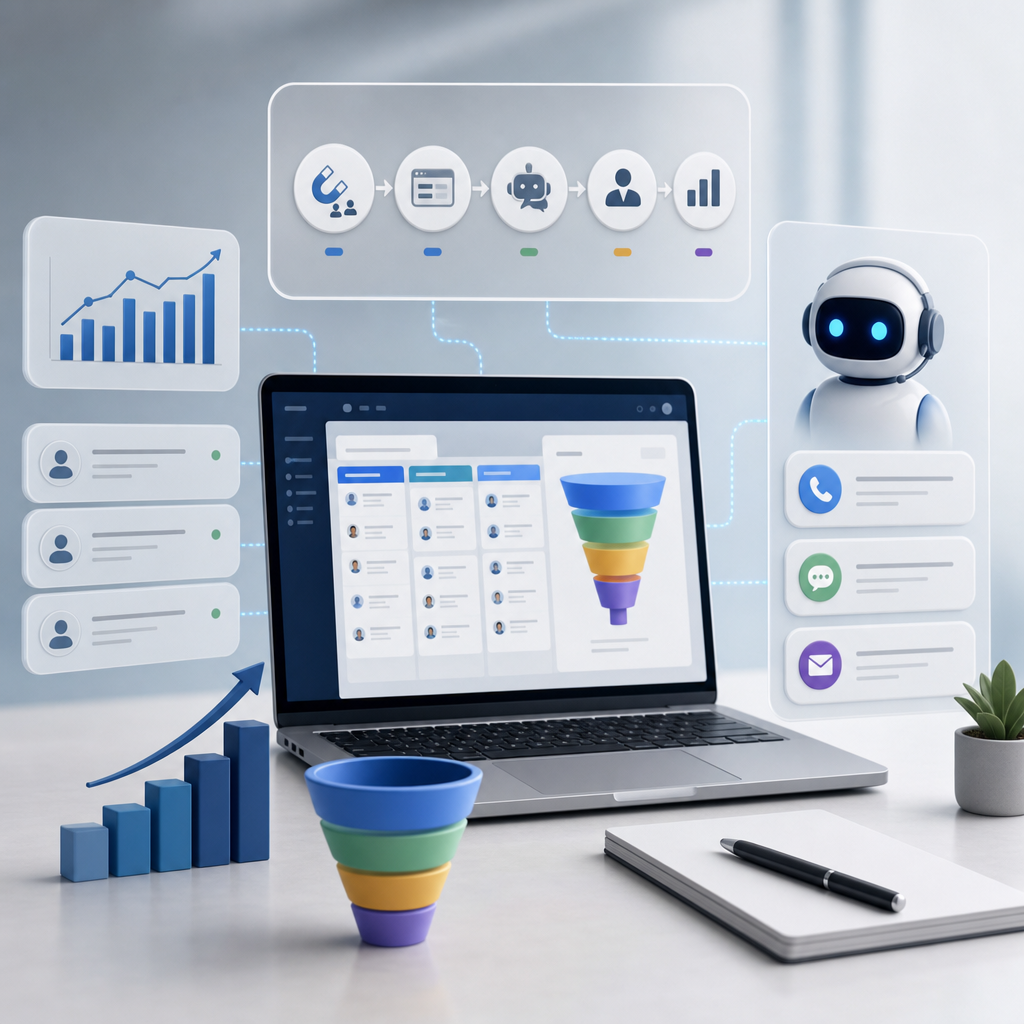
AI Agents: Your Always-On Sales and Support Infrastructure
AI agents transform how you handle repetitive customer interactions and lead engagement without adding headcount.
An AI voice agent can handle initial discovery calls, qualify leads based on your criteria, schedule meetings with your team, and answer common questions. A chatbot can nurture inbound website visitors, answer FAQs, and capture information that pre-qualifies prospects before human contact.
The advantage isn’t just efficiency. It’s consistency and speed. Your best salesperson gets sick. An AI agent doesn’t. A prospect reaches out at 2 AM. An AI agent answers immediately. You want to follow up with 200 leads. An AI agent does it simultaneously.
We’ve deployed AI agents that increased initial response time from 6-12 hours to under 60 seconds, capturing interest while it’s fresh. They also collect structured data that your sales team can use immediately, eliminating the “tell me about your business” dance.
The key is training AI agents on your specific value prop, process, and decision criteria so they represent your business accurately and don’t lose deals to poor handoff.
The 30-Day Lead Guarantee: How We Deliver Predictable Results
We built our 30-day lead guarantee because we’re confident in what a properly architected system delivers.
When you engage us for a custom CRM and sales funnel, we commit to generating 10+ qualified leads within 30 days using a combination of optimized lead capture, strategic outreach, and AI-assisted prospecting. If we don’t hit that number, we continue working at no additional cost until we do.
This guarantee is possible because we control multiple variables: your lead sources are systematized, your funnel doesn’t leak, your follow-up is automated, and your team isn’t distracted by admin work.
The leads we deliver are qualified by your criteria. They’re not vanity metrics. They’re prospects with genuine intent, timeline, and need for your solution.
This approach shifts the risk from you to us. We have skin in the game to build something that actually works instead of just installed and forgotten.
Integration and Implementation: Seamless Deployment Into Your Business
The best system is worthless if deployment derails your business or takes six months to go live.
We implement in phases over 30-60 days. First phase is data migration and core CRM setup while your team continues normal operations. Second phase is funnel automation and AI agent training. Third phase is team training and optimization based on real usage.
We integrate with your existing stack: accounting software, marketing platforms, communication tools, and payment processors. Data flows automatically so your team isn’t manually syncing between systems.
Implementation includes team training, but more importantly, it includes defining exactly how your team will use the system. A CRM is only as good as adoption. We document your processes, create simple runbooks, and ensure every team member knows what their role is.
Most deployments see rapid traction. One manufacturing company we worked with saw their sales team adopt the new CRM within two weeks and immediately started citing data they could only find before by digging through emails.

Measuring ROI: Dashboard Visibility and Real-Time Performance Tracking
You can’t optimize what you can’t measure. Our custom systems include an analytics dashboard that gives you real-time visibility into what matters: pipeline health, lead source quality, funnel conversion rates, sales cycle length, and revenue forecast accuracy.
These dashboards answer specific questions:
- Which lead sources produce the highest-quality prospects?
- Where are prospects stalling in your funnel?
- What’s your actual sales cycle versus your forecast?
- Which team members are most efficient?
- What’s the true ROI on your acquisition spending?
You don’t need vanity metrics. You need data that drives decisions. We set up dashboards so your leadership team can see pipeline health at a glance, your sales team can identify next actions without guesswork, and your ops team can forecast cash flow with confidence.
Most clients report 15-25% improvement in forecast accuracy within 60 days simply because they’re working from clean, real-time data instead of spreadsheets updated weekly.
Why Custom Builds Beat Off-the-Shelf Solutions for Scaling Teams
As you scale, your business becomes more specific, not less.
Off-the-shelf platforms optimize for the median customer. That might work when you’re small. But once you’re managing complex deal structures, multiple revenue streams, or team specialization, generic software creates friction at scale.
A custom build is designed for your specific business model. It automates what’s unique to you. It captures data that matters to you. It reports on metrics that drive your strategy.
It also costs less over time. You’re not paying for features you don’t use. You’re not paying consultants to customize rigid platforms. You’re not losing revenue to process inefficiency.
We’ve tracked the total cost of ownership for clients who migrated from expensive off-the-shelf platforms to custom systems. Most see 30-40% reduction in total software and labor costs within year one, while simultaneously improving operational efficiency.
Getting Started: From Consultation to Revenue Growth
The first step is simple: a strategic consultation where we understand your business model, your current pain points, and your growth targets.
We’ll map your current customer lifecycle, identify where revenue is leaking, and outline what a custom CRM and funnel system could deliver for your business. We’ll also explain our process, timeline, and investment so there are no surprises.
From that conversation, we’ll develop a proposal outlining the specific system architecture, implementation timeline, and the results we’re committing to deliver.
If it makes sense, we move forward. If not, we’ll give you honest feedback and, if appropriate, a roadmap for what you could tackle yourself.
The business case is usually clear once we’ve mapped your opportunity. Most scaling operators we talk to have 15-30% of revenue leaking through process inefficiency or lead leakage. Recovering even half of that makes the investment in a custom system pay for itself in months.
Ready to stop losing revenue to fragmented systems? Reach out and let’s have a conversation about what a predictable, scalable revenue system could look like for your business.